
Love Compatibility Beyond Sun Signs

Compatibility beyond Sun signs means comparing more of each chart than the star sign column in a magazine. Vedic astrology gives most weight to the Moon, read for feelings and daily rhythm, and to Venus, read for affection and taste. Even so, no chart comparison is proven to predict how a relationship will go.
A star sign compatibility chart is easy to love. You find your sign, find theirs, and get a verdict in seconds. The trouble is that it compares one small fact about two people who are each far more complicated than a single column in a table.
Vedic astrology has never put much weight on the Sun sign for love. This guide explains why, what it looks at instead, and why even the fuller picture deserves a light touch.
Key takeaways
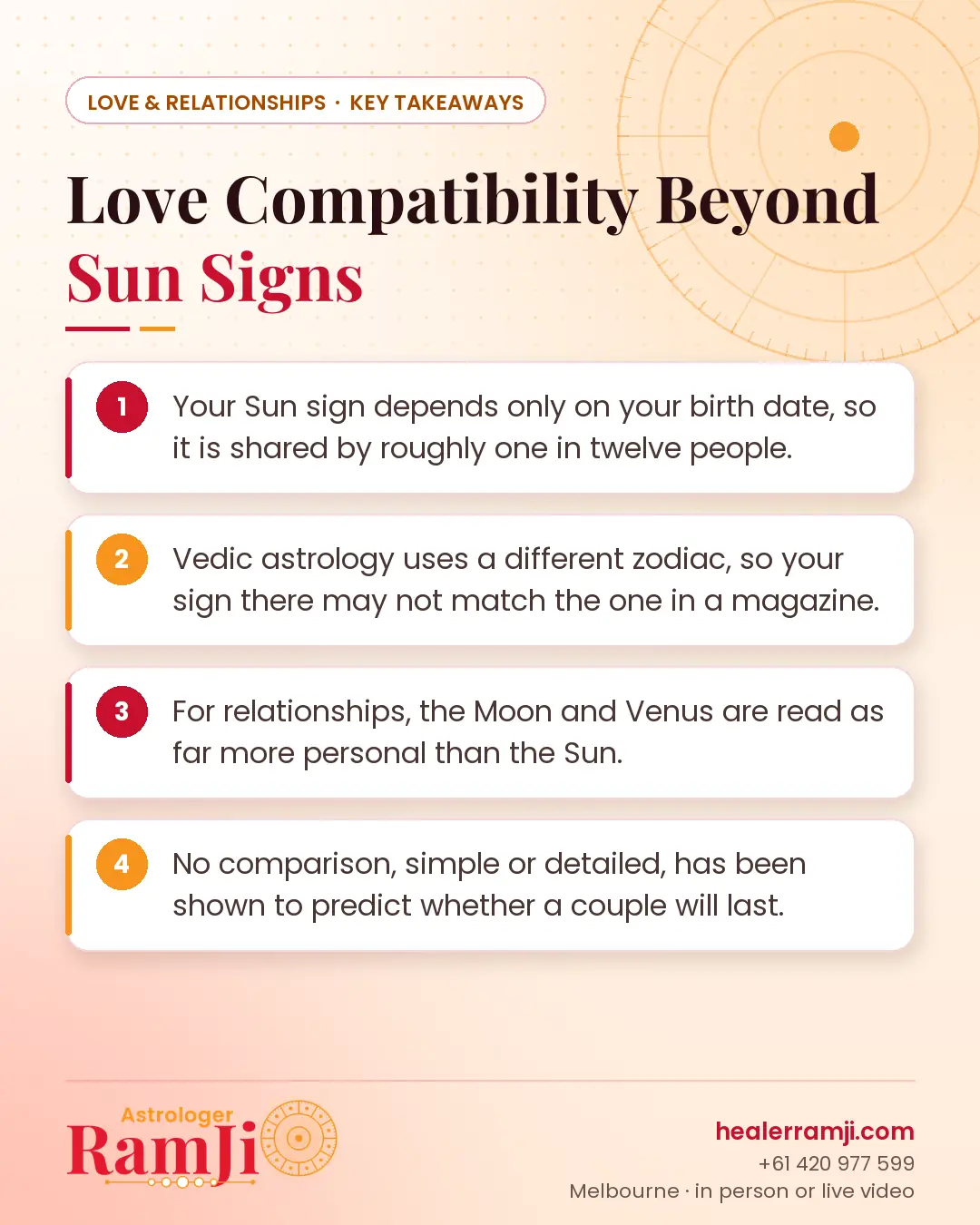
- Your Sun sign depends only on your birth date, so it is shared by roughly one in twelve people.
- Vedic astrology uses a different zodiac, so your sign there may not match the one in a magazine.
- For relationships, the Moon and Venus are read as far more personal than the Sun.
- No comparison, simple or detailed, has been shown to predict whether a couple will last.
Why do Sun sign charts say so little?
The Sun spends about a month in each sign. Everyone born in that month shares it, whatever the year, place or time. That makes a Sun sign a very blunt tool for describing one person, let alone two together.
There is a second problem. Western astrology mostly uses the tropical zodiac, tied to the seasons. Vedic astrology uses the sidereal zodiac, tied to the stars. The two have drifted apart by more than 20 degrees, and the exact figure depends on which correction, or ayanamsa, an astrologer uses, as this overview of sidereal and tropical astrology explains. Many people find that their Vedic Sun sign is the sign before the one they grew up with. Our article on why your sign may change in Vedic astrology covers this in more detail.
So a couple described as a "perfect Leo and Sagittarius match" may not be Leo and Sagittarius at all in the system their grandparents used.

Why does Vedic astrology look to the Moon?
In Vedic tradition the Moon is read for the mind, moods and emotional needs. It moves fast, changing sign roughly every two and a half days and passing through a nakshatra, or birth star, in about a day. That speed makes it much more individual than the Sun.
It is also the basis of traditional matchmaking. The well-known Guna Milan matching used before many marriages works from each person's Moon sign and nakshatra, not their Sun sign. When a family asks for your "rashi", they usually mean your Moon sign.
In a dating context, readers use the Moon to ask practical questions:
- How does each of you behave when tired or upset?
- Does one of you need to talk things through while the other needs space?
- Do your daily rhythms suit each other, or will one of you always be waiting?
These are questions worth asking whether or not you believe in astrology. The chart simply gives you a starting point.
What does Venus add?
Venus, or Shukra, is linked with attraction, affection, beauty and pleasure. Where the Moon describes what soothes you, Venus describes what delights you. A reader comparing two Venus placements might talk about:
- How each person shows love, such as with words, time, gifts or practical help
- What each finds attractive, and whether that has changed over the years
- Shared tastes in home, food, music or social life
Venus usually spends a few weeks in a sign, so it is less personal than the Moon but often differs between people born only weeks apart. Some readers also compare Mars, linked with drive and desire, alongside Venus.

Is a Moon and Venus comparison more accurate?
It is more detailed, and it is closer to how the tradition works. That isn't the same as accurate. One large study of Swedish register data found no consistent evidence that couples with "compatible" signs were more likely to marry or less likely to divorce. It tested popular sign rankings, not a full Vedic comparison. Still, there is no reliable evidence that a deeper method predicts how couples fare either.
A fair way to put it is that Moon and Venus comparisons are better conversation starters. They give you more specific things to talk about. They don't give you a verdict. Our short answer on how much confidence to place in compatibility readings sets out a realistic view.
What do you need for a fuller comparison?
Your Sun sign needs only a date. A Moon comparison needs a date and, ideally, a time, because the Moon can change sign or nakshatra during the day. Anything involving houses, such as the seventh house of partnership, needs a reliable birth time and place for both people.
That raises a practical point. Asking someone for their exact birth time on a third date can feel like a lot. Only compare charts when the other person knows and agrees. If they would rather not share, your own chart can still be read for how you tend to love.
How should you use what you learn?
- Treat each point as a question, not a fact. If a reading says one of you withdraws under stress, ask each other whether that fits.
- Give more weight to what you can see. Kindness, respect, honesty and how you handle disagreements tell you far more than any placement.
- Don't let a hard comparison end a good relationship. Many couples do well across real differences. See what couples with difficult charts can do differently.
- Don't let a flattering comparison excuse poor treatment. Good chart links never make unkindness acceptable.

Where does a compatibility reading fit?
A love compatibility reading compares Moon signs, birth stars, Venus and Mars for couples who are dating. It gives no score and no pass or fail. It is meant to open up a conversation between the two of you, and it is up to you how much weight to give it.
Astrology is a traditional practice, not a science. Sessions can be held by phone, WhatsApp or video, which suits couples joining from different places, and any fee is stated before paid work begins. If you are curious, get in touch.
Related service
Keep reading

Can a Low-Compatibility Relationship Work?
Told your charts are a poor match? What low compatibility usually points to, and the practical habits couples with difficult charts can build together.
Read article →
Making Melbourne to India Long Distance Work
A long distance relationship between Australia and India runs on time zones, visits and two families. Practical ways to plan calls, share travel and talk openly.
Read article →
Relationships While Studying Abroad in Australia
Relationship advice for international students in Australia: how loneliness and pressure bend judgement, which decisions to slow down, and where to get real help.
Read article →Quick answers
How accurate is love compatibility astrology?
Love compatibility astrology isn't accurate in any measurable sense. Here is what the evidence says, and how to use a compatibility reading sensibly.
Read answer →Can astrology bring my ex back?
No, astrology can't make your ex come back, and nobody can honestly promise it. Here is what a reading can help with, and how to avoid costly promises.
Read answer →Talk to Vijay Ramji
Tell us what you are facing. If a reading is unlikely to help, you will be told that plainly.