
Samudrika Shastra: An Introduction
Samudrika Shastra is a traditional Indian body of knowledge that reads bodily features, such as the face, palms and marks, as signs of temperament and fortune. Its meaning is roughly knowledge of body features. It is a cultural tradition, not a science, and it should never be used to judge, hire or reject anyone.
If you grew up around Indian astrology, you may have heard an elder comment on the shape of a forehead, a mole on a cheek or the lines of a newborn's hand. Those comments often come from Samudrika Shastra, a tradition that is older and wider than most people realise.
This introduction covers what the tradition is, where it comes from and how it is divided. It also explains, plainly, why it should never be used to judge another person.
Key takeaways
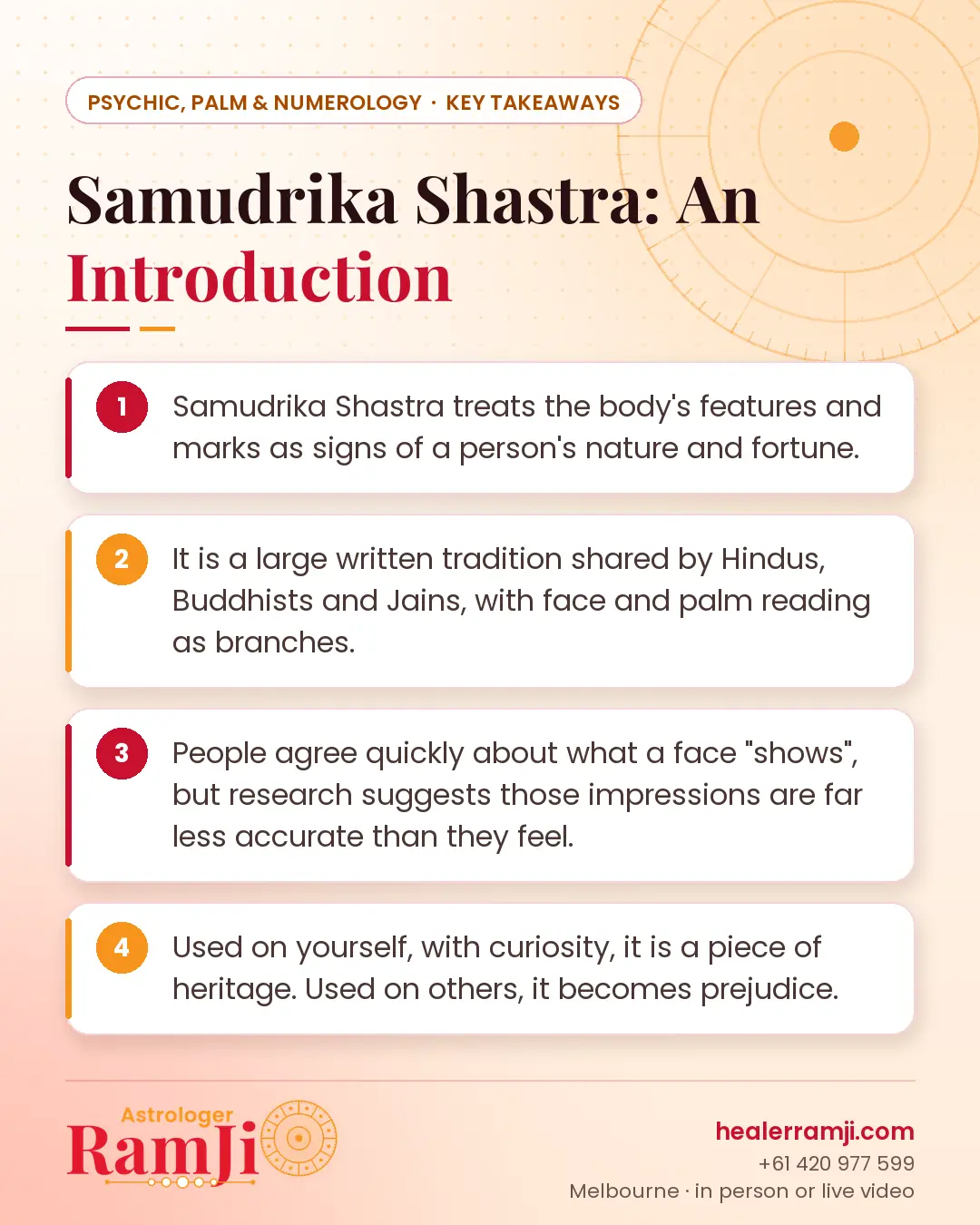
- Samudrika Shastra treats the body's features and marks as signs of a person's nature and fortune.
- It is a large written tradition shared by Hindus, Buddhists and Jains, with face and palm reading as branches.
- People agree quickly about what a face "shows", but research suggests those impressions are far less accurate than they feel.
- Used on yourself, with curiosity, it is a piece of heritage. Used on others, it becomes prejudice.
What does Samudrika Shastra mean?
The Sanskrit term is usually rendered as knowledge of body features. Samudra means the ocean, and one manuscript from Nepal frames the teaching as a dialogue between the river goddess Ganga and Samudra. Popular accounts tell other origin stories, and they don't all agree.
The central belief is that natural and acquired marks on the body reflect a person's psychology and destiny. Texts discuss the proportions and shape of features, along with marks such as moles and birthmarks. Some teachers describe it as whole-body analysis, while most people today meet only its face and palm branches.
It helps to see Samudrika as a family of related practices, not a single method. Two readers trained in different lineages can look at the same face and say quite different things.
What are its branches?
The tradition covers the whole body, but some parts have grown into practices of their own:
- Hasta samudrika: palm reading, the best known branch today. Our guide to the main palm lines covers it.
- Mukha samudrika: face reading, which looks at the forehead, eyes, nose, mouth and chin.
- Kapala samudrika: reading the shape of the head.
Some teachers also link features to the five elements of earth, water, fire, air and space, and describe body types in those terms. Teachers and texts often disagree about what a given feature means.
How old is the tradition?
Ideas about auspicious bodily marks appear in legends of Rama, Krishna, the Buddha and Mahavira. The Garuda Purana takes up the subject, and many manuscripts include extracts from the Brihat Samhita, an older astrological work.
The dedicated literature is large but patchy. One of the earliest important works usually cited, the Samudrika-tilaka, was begun around 1160 CE and completed around 1175. A later text, the Samudrika-chintamani, follows it closely. Around 600 manuscripts are known, many anonymous or attributed to legendary authors, and no comprehensive study of them has yet been done.
Similar ideas have appeared in many other cultures, from European physiognomy to Chinese face reading. That spread shows how natural it is for people to read character into faces. It doesn't show that the readings are right.
Why does a face seem to reveal so much?
Because our brains are built to make snap judgements. A major review in the Annual Review of Psychology, summarised by Princeton University, notes that people agree with each other about traits read from faces, and reach that agreement with surprisingly little time and effort. Those impressions even predict real outcomes, such as who gets chosen as a leader.
The same review argues that the accuracy of these impressions has been greatly overstated. In other words, we agree, we act on it, and we are often wrong. That is exactly why a tradition built on reading faces needs careful handling.

Why should it never be used to judge people?
Faces and bodies are shaped by ancestry, age, illness, injury, nutrition and chance. None of these says anything about honesty, ability or worth. Readings that sort features into auspicious and inauspicious can easily become labels that follow a person for life.
So please don't use Samudrika, or any face or body reading, to:
- choose or reject a prospective spouse
- screen a job applicant, employee or business partner
- decide whether to rent to someone
- predict what a child will become
- read anyone's features without their clear agreement
There is a legal side too. In Victoria, the Victorian Equal Opportunity and Human Rights Commission explains that physical features under the Equal Opportunity Act include height, weight, size, shape, facial features, hair and birthmarks, and that discrimination on that basis is against the law in areas of public life such as work, education and rental properties. A traditional text is no defence.
How can you engage with it respectfully?
Many people value Samudrika as part of their culture, and there is nothing wrong with that. Some respectful ways in:
- Read about its history and texts as you would any classical tradition.
- Use a reading of your own face or hands as a prompt for reflection, and disagree freely.
- Treat a reader's comments as an interpretation of an old text, never a finding about you.
- Take a new or changing mole to your GP, not to a reader. That is a health question.
If a reader uses your features to frighten you and then sells a remedy, walk away. Our short answer on whether psychic readings are real is a useful comparison for weighing claims like these.
Would a reading suit you?
If you are curious about how the tradition reads your own face, Samudrika face reading can be held on its own or alongside a chart, with you free to leave out any comment. A palm reading draws on the same family of practices. Sessions can be held by phone, WhatsApp or video, what you share is confidential, and any fee is stated before paid work begins. If you'd like to explore it, get in touch.
Related service
Keep reading
How to Work Out Your Birth and Destiny Numbers
How to calculate your destiny number and birth number, step by step, with a worked example, a check for master numbers, and the name-based method compared.
Read article →
Vedic and Pythagorean Numerology Compared
Why do Vedic and Pythagorean numerology give different numbers for the same name? A clear comparison of letter charts, birth numbers and what each system emphasises.
Read article →
Does Your House Number Matter?
What house number numerology says about each number from 1 to 9, why traditions disagree, and sound reasons not to pass on a good home over its number.
Read article →Quick answers
What is the difference between a psychic and an astrologer?
An astrologer works from a chart calculated from birth details, while a psychic relies on intuition. Here is how that changes what each reading can offer.
Read answer →Are psychic readings real?
Readings can feel real and meaningful, but no scientific proof shows that psychic powers exist. Here is what a reading can offer and when to walk away.
Read answer →Talk to Vijay Ramji
Tell us what you are facing. If a reading is unlikely to help, you will be told that plainly.