
Face Reading
An old tradition, read as a complement to your chart.
Samudrika face reading is a traditional Indian practice that interprets facial features as signs of temperament. It can sit alongside a birth chart as a prompt for self-reflection. There is no scientific evidence that a face reveals character or fate, and it should never be used to judge anyone, including a partner or employee.
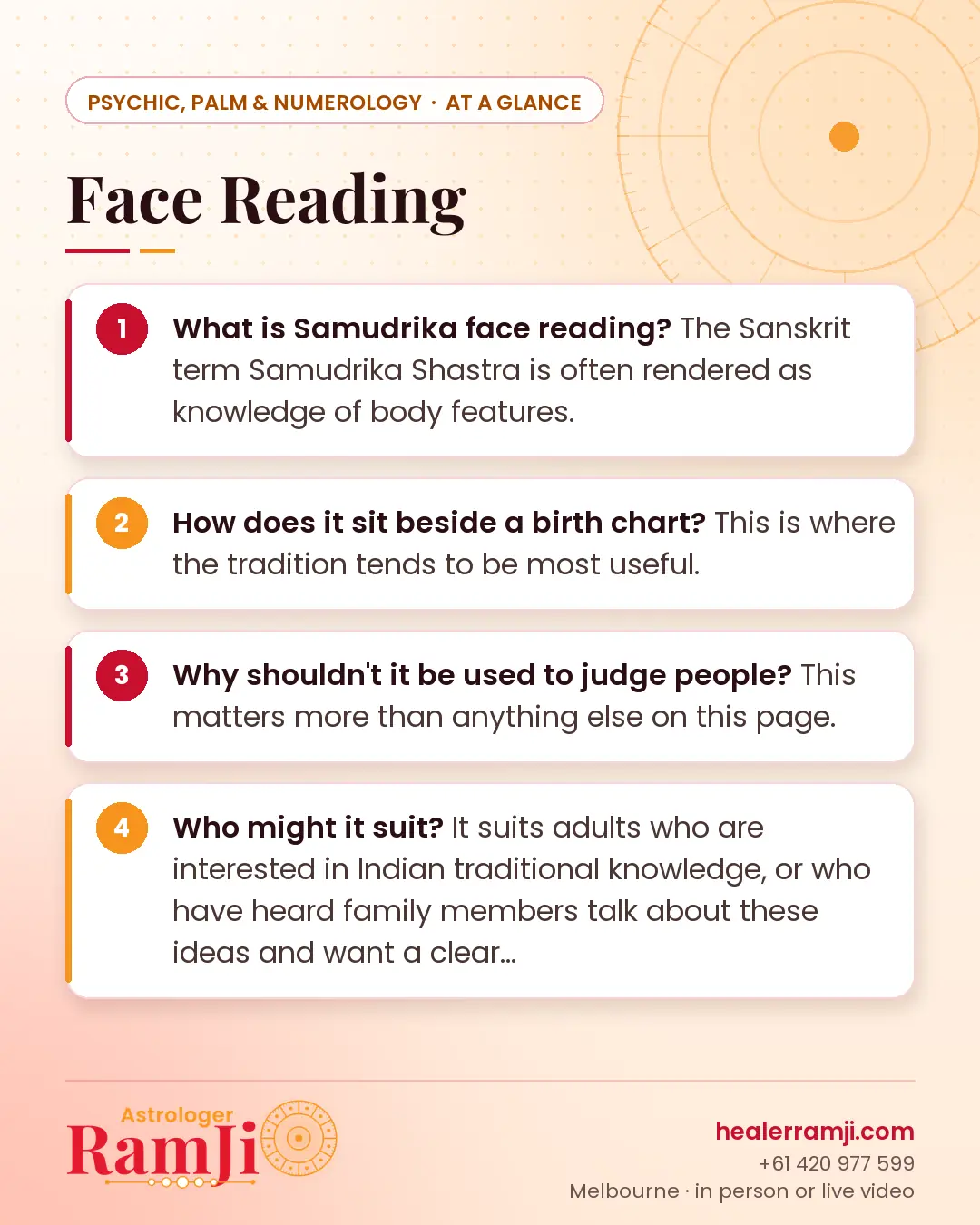
What is Samudrika face reading?
The Sanskrit term Samudrika Shastra is often rendered as knowledge of body features. It is a large body of writing rather than a single book, shared across Hindu, Buddhist and Jain traditions. Face reading (mukha samudrika) is one branch of it, and palm reading (hasta samudrika) is another. One of the earliest important works usually cited, the Samudrika-tilaka, dates from the twelfth century. Hundreds of manuscripts survive, and many have never been properly dated or studied.
The tradition holds that the marks and features of the body reflect a person's psychology and fortune. Traditional texts discuss the shape and proportion of the forehead, eyes, nose, mouth and chin, along with marks such as moles. Texts and teachers don't always agree on what any of these mean. If you would like more history, read our introduction to Samudrika Shastra.
How does it sit beside a birth chart?
This is where the tradition tends to be most useful. A kundli reading starts from calculated data: your date, time and place of birth. Face reading adds a different prompt, drawn from the person actually in the conversation. A reader may notice that the chart's picture of you and the traditional reading of your features point in similar directions, or in different ones. Either can raise a useful question about how you see yourself.
Two practices agreeing does not prove anything. Neither one is a test of the other. Think of it as hearing the same question asked in a second language: you may notice something new, but you haven't gained certainty.
It can stand on its own too. If you have no reliable birth time, you could pair it with a palm reading, which comes from the same family of practices.
Why shouldn't it be used to judge people?
This matters more than anything else on this page. Faces are shaped by ancestry, age, illness, injury and chance. History offers plenty of examples of face reading being used to rank people. It should not be used that way now.
Psychology gives a further reason for caution. People form quick impressions of character from a face and often agree with each other, which makes those impressions feel true. A major review published in the Annual Review of Psychology, summarised by Princeton University, argues that their real accuracy has been greatly overstated.
So please don't use a face reading to choose a business partner, screen a tenant or an employee, or decide whether a prospective spouse can be trusted. Decide those things on conduct, references and proper checks.
Who might it suit?
It suits adults who are interested in Indian traditional knowledge, or who have heard family members talk about these ideas and want a clear account. It can also suit people who have already had a chart reading and would enjoy a different lens. It's a poor fit if you are hoping to learn something fixed about your future, or if your appearance is a source of real distress. If that's the case, a GP or psychologist would serve you far better, and no one should comment on your features.
What happens in a session?
You will usually be asked why you are curious and what you would like to reflect on. Sessions can use video, or clear photos if you prefer. A reader then describes what the tradition says about particular features and asks whether it rings true for you. You can disagree, and you can ask for any comment to be left out. You may also be asked whether you have a chart you would like to bring in.
If you are sending photos, a plain front view and a side view in soft daylight are usually enough. Leave off filters and beauty modes, which change the features being discussed. Send them privately, and only of yourself.
What can't it do?
It can't reveal your character, tell you how long you will live or predict your wealth or marriage. Nor can it tell you whether surgery or a cosmetic procedure will change your luck, and you should never have a procedure for that reason. A reader's comment is an interpretation of an old text, not a finding about you.
If anyone uses your features to frighten you and then sells you a remedy, walk away. Our list of red flags in readings applies here too.
What does it cost?
Ask when you get in touch. Any fee is stated before paid work begins, and that includes any session combining face reading with a chart.
How do I get in touch?
You can call or send a WhatsApp message to +61420977599, or use the contact form. Vijay Ramji is based in Ascot Vale, with appointments arranged in advance, and sessions can be held by phone, WhatsApp or video.
Common questions
Can you read my partner's or a job applicant's face from a photo?
That isn't something a responsible reader should do. Reading someone who hasn't agreed to it invades their privacy, and appearance is no basis for trusting, hiring or rejecting anyone. Stick to your own face and your own questions.
Is face reading the same as reading expressions?
No. Noticing that someone looks tired or tense is ordinary human observation about the moment. Samudrika looks at fixed features and marks, and that is the part with no scientific support.
Should I worry about a mole or mark a reader commented on?
Not because of what a reader said. Tradition gives meanings to marks, but they say nothing reliable about your future. If a mole is new or changing, however, show it to your GP. That is a health question.
Do I need a chart as well?
No, you can ask for the face reading on its own. Some people like to compare it with a chart, and either way it's your choice. If you are weighing up this kind of practice in general, our short answer on whether psychic readings are real is a useful comparison.
Can you read a child's face?
It's better not to. Children's faces change as they grow, and a label given early can stick. A tradition like this should never be used to decide what a child is like or what they will become.
Related services
Numerology Reading
A numerology reading in Melbourne with Vijay Ramji: your birth number and destiny number read together, with plain talk on what the numbers can't tell you.
View service →
Gemstone Consultation
An astrology gemstone consultation that may end with no stone at all. Learn why, how to avoid overpaying, and how to check a certificate before you buy.
View service →Read more
Samudrika Shastra: An Introduction
Samudrika Shastra meaning, history and branches explained, plus why this old tradition of reading the body should never be used to judge or screen other people.
Read article →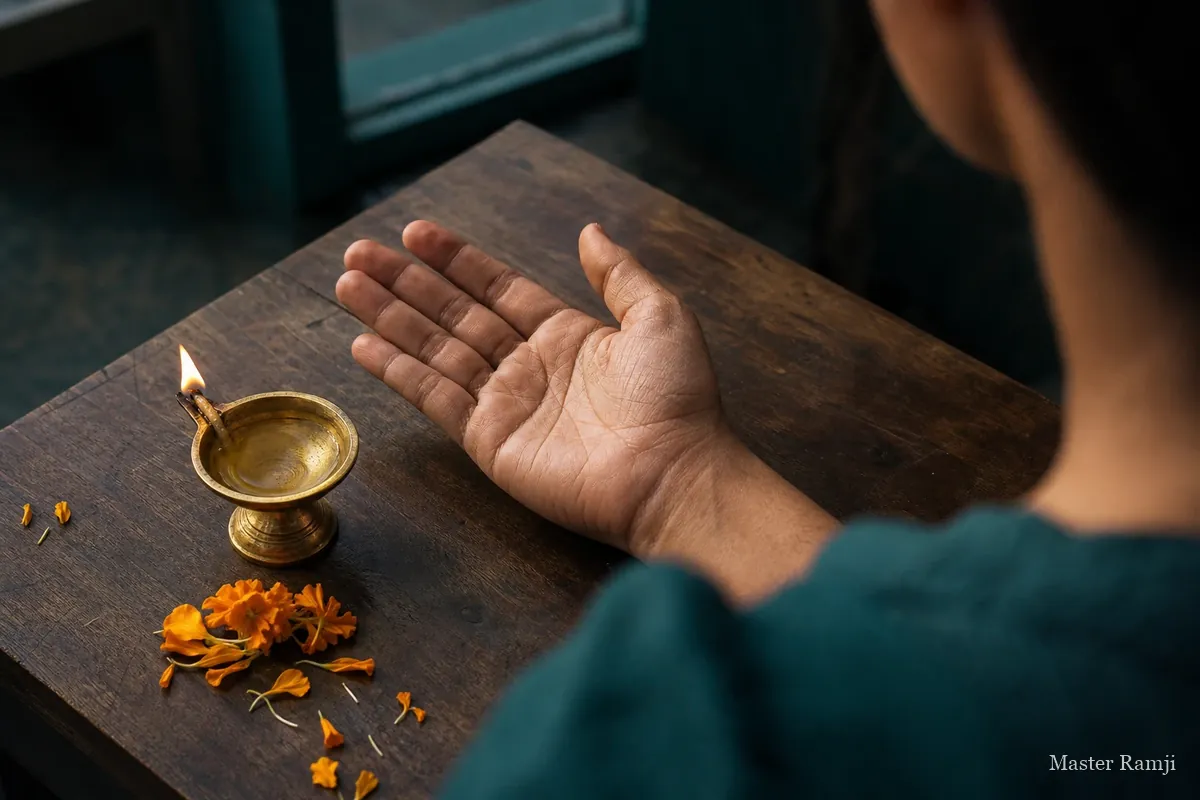
The Main Palm Lines and What They Are Read For
The meaning of palm lines in the palmistry tradition: what the life, head, heart and fate lines are read for, and why they can't predict your death or illness.
Read article →
No a Short Life Line Does Not Mean a Short Life
A short life line does not mean a short life. What the tradition really says, what the few studies found, and what to do if a reader has frightened you.
Read article →Quick answers
What is the difference between a psychic and an astrologer?
An astrologer works from a chart calculated from birth details, while a psychic relies on intuition. Here is how that changes what each reading can offer.
Read answer →Are psychic readings real?
Readings can feel real and meaningful, but no scientific proof shows that psychic powers exist. Here is what a reading can offer and when to walk away.
Read answer →Talk to Vijay Ramji
Tell us what you are facing. If a reading is unlikely to help, you will be told that plainly.