
The Main Palm Lines and What They Are Read For
The meaning of palm lines in palmistry is about temperament, not fixed events. The life line is linked with vitality and big changes, the head line with thinking, the heart line with emotion, and the fate line with work. This is a tradition, not science, and it can't predict illness or death.
Look at your open hand and you will see a few deep creases and many fine ones. Palmistry has spent centuries giving them names and stories. Unfortunately, some of those stories have turned into scares passed around in families and on social media.
This guide explains where each main line runs and what it is traditionally read for, with the fear taken out. It also covers what a line can't tell you.
Key takeaways
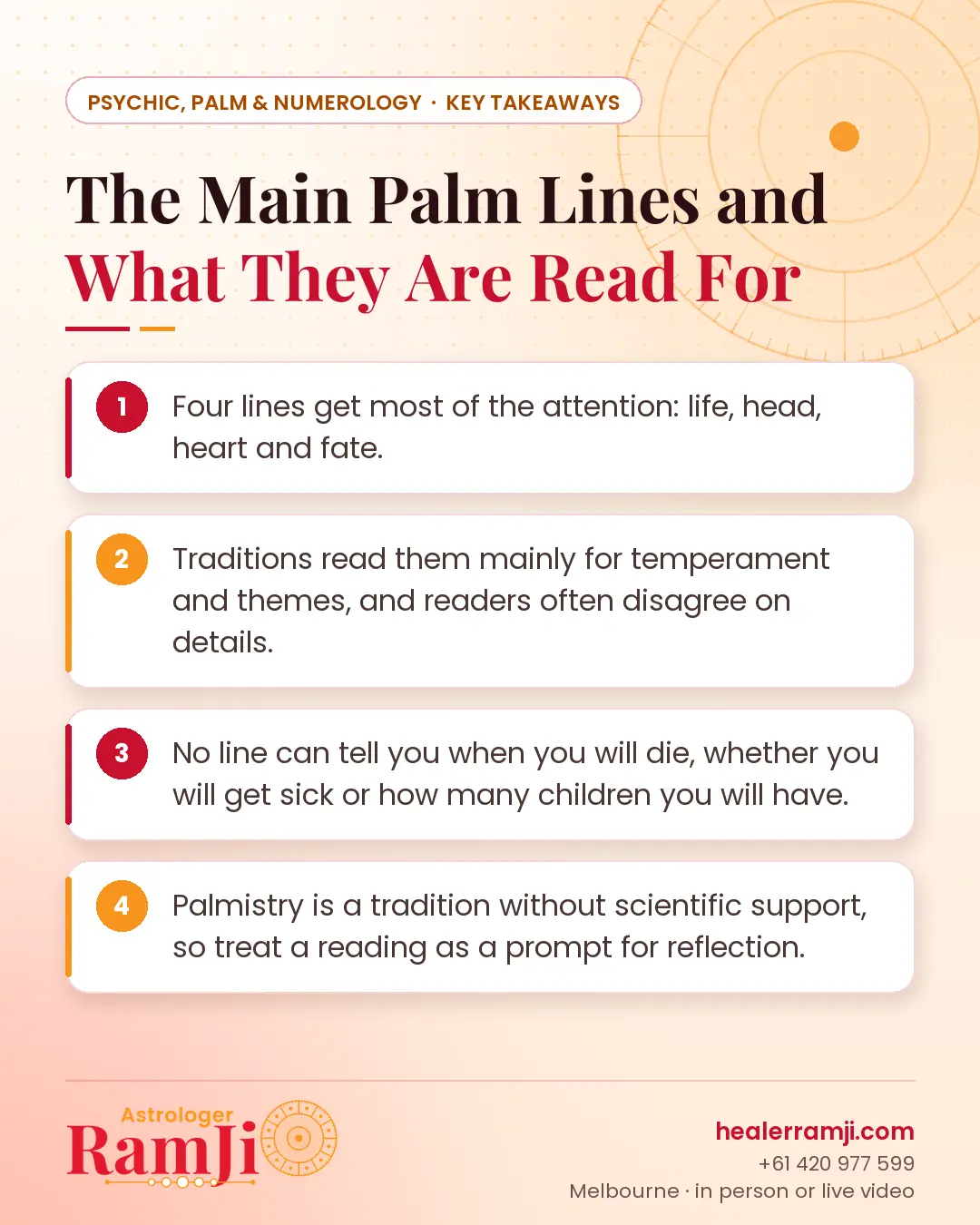
- Four lines get most of the attention: life, head, heart and fate.
- Traditions read them mainly for temperament and themes, and readers often disagree on details.
- No line can tell you when you will die, whether you will get sick or how many children you will have.
- Palmistry is a tradition without scientific support, so treat a reading as a prompt for reflection.
What are palm lines, physically?
They are skin creases where the hand folds. According to MedlinePlus, the main creases form before birth, most often by the 12th week of pregnancy. That's a useful fact to hold on to. These lines start forming long before you have had a single life experience.
Palmistry is found in several cultures, including the Indian tradition where hand reading sits within Samudrika Shastra, and the Western tradition shaped by medieval and 19th-century writers. It is widely regarded as a pseudoscience. The meanings below are what the tradition says, not established facts about you.
What is the life line read for?
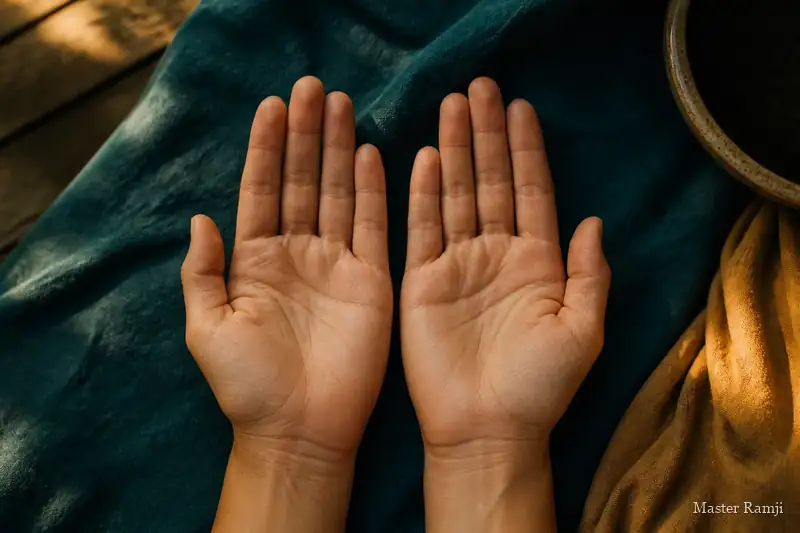
The life line, or jeevan rekha in Hindi, curves around the base of the thumb, starting between the thumb and index finger.
Despite the name, readers generally link it with vitality, stamina, your sense of grounding and major changes of direction. A deep, clean line is usually described as steady energy, while a faint or chained one may be read as energy that comes and goes. A break is often described as a turning point, like a move, a job change or a new beginning.
It is not a clock. If you have heard otherwise, read why a short life line doesn't mean a short life.
What is the head line read for?
The head line usually begins close to the life line and runs across the middle of the palm. It is linked with how you think, not how clever you are.
- A straighter line is often read as practical, step-by-step thinking.
- A line curving towards the wrist is often read as imaginative or reflective thinking.
- A long line is sometimes linked with weighing many options, and a shorter one with quick decisions.
Treat these as conversation starters. Your head line can't assess your intelligence or tell you which career to pick.
What is the heart line read for?
The heart line runs across the top of the palm, under the fingers. Readers link it with emotional style and how you relate to others. A line that rises towards the index or middle finger may be read as warm and outward-looking, while a straighter one may be read as more reserved or private.
What this line can't do is tell you whether your relationship will last. It says nothing about your partner, who has their own hands and their own choices. If love is the real question, talk to the person concerned. A counsellor is often more useful still when a relationship is under strain.
What is the fate line read for?
The fate line, or bhagya rekha, runs vertically up the middle of the palm towards the middle finger. It is linked with work, duty and the outside forces that shape your path.
Plenty of people have a faint, broken or barely visible fate line. It is often taken to mean a person who makes their own way, or simply one whose work has changed many times. It doesn't mean you have no future or bad luck, and readers should say so plainly. Its name makes it sound more decisive than any tradition really supports.
What do readers look at besides the lines?
A careful reading looks at the whole hand, because a line means little in isolation. That can include:
- The shape of the palm and the length of the fingers
- The raised pads, or mounts, at the base of each finger and thumb
- The depth and clarity of a line, not only its length
- The difference between your two hands, which we cover in left or right hand: which is read?
Smaller lines also get names, such as marriage and children's lines. Treat these with special care. A crease on the side of your hand can't count your future children or tell you about your fertility. For those questions, a GP is the right person to ask.
What if your hand doesn't look like the diagrams?
Very few do. Lines can be missing, doubled, joined or broken. Some people have a single crease across the palm where the head and heart lines seem to merge. MedlinePlus says this is often normal and that about 1 in 30 people have one, though in some cases it can be linked with certain developmental conditions. That is a matter for a doctor, not a palm reader, and no reader should diagnose anything from it.
Lines can also look different with age, skin condition, swelling or injury, which we discuss in do palm lines change over time? If you notice a sudden change in your hands, such as swelling, numbness or skin changes, see a GP and leave palmistry out of it.
Can you read your own palm?
You can certainly enjoy it. Look at your hand in good light, find the four lines and see whether the descriptions ring true. Just notice how flexible they are. A line described as "reserved but loyal" fits a great many people, which is one reason a reading can feel so accurate. If it makes you curious about yourself, that is a good result. If it makes you anxious, put it down.
What makes a reading worthwhile?
A good reader describes tendencies, invites you to disagree, and never predicts your death, an illness or a disaster. Fear followed by a fee is a warning sign. Our palm reading service treats the hand as a starting point for conversation and can be done by phone, WhatsApp or video using clear photos of your palm. Fees are stated before paid work. If you would like to ask about it, please get in touch.
Related service
Keep reading
No a Short Life Line Does Not Mean a Short Life
A short life line does not mean a short life. What the tradition really says, what the few studies found, and what to do if a reader has frightened you.
Read article →
Left or Right Hand: Which Is Read?
Which hand is read in palmistry? What Indian, Chinese and Western traditions say about left and right, how readers decide, and what left-handers should do.
Read article →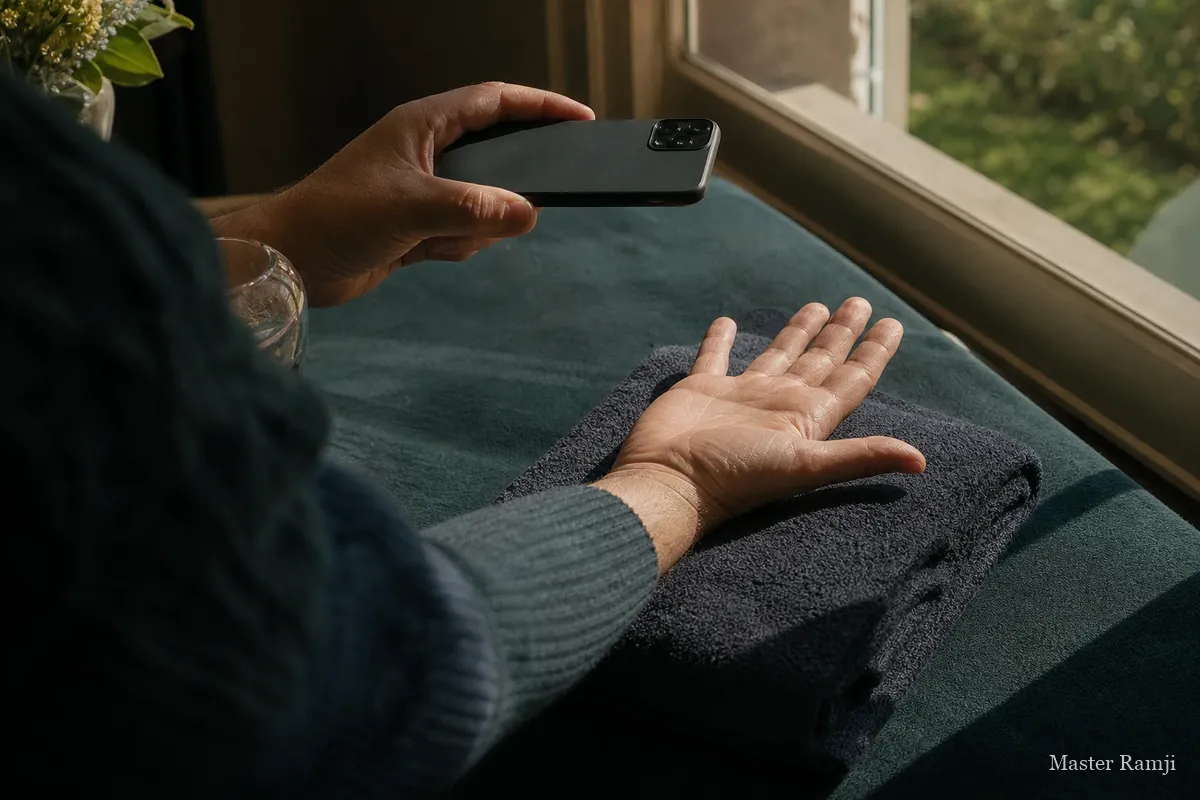
How to Photograph Your Palm for a Reading
How to take a palm photo for a reading: the right light and angle, which shots a reader needs, phone settings to change, and how to protect your privacy.
Read article →Quick answers
Do palm lines change over time?
The main palm creases form before birth and stay largely the same, while fine lines can shift with age and skin. Here is what that does and doesn't mean.
Read answer →What is the difference between a psychic and an astrologer?
An astrologer works from a chart calculated from birth details, while a psychic relies on intuition. Here is how that changes what each reading can offer.
Read answer →Talk to Vijay Ramji
Tell us what you are facing. If a reading is unlikely to help, you will be told that plainly.