
Why Online Horoscope Matching Is Not Enough
Online horoscope matching accuracy depends on your birth details and the calculator's settings. Most tools add up 36 Guna Milan points correctly but skip exceptions, the wider chart and your real life. Treat the result as a first look, check the inputs, and don't make a marriage decision from one number.
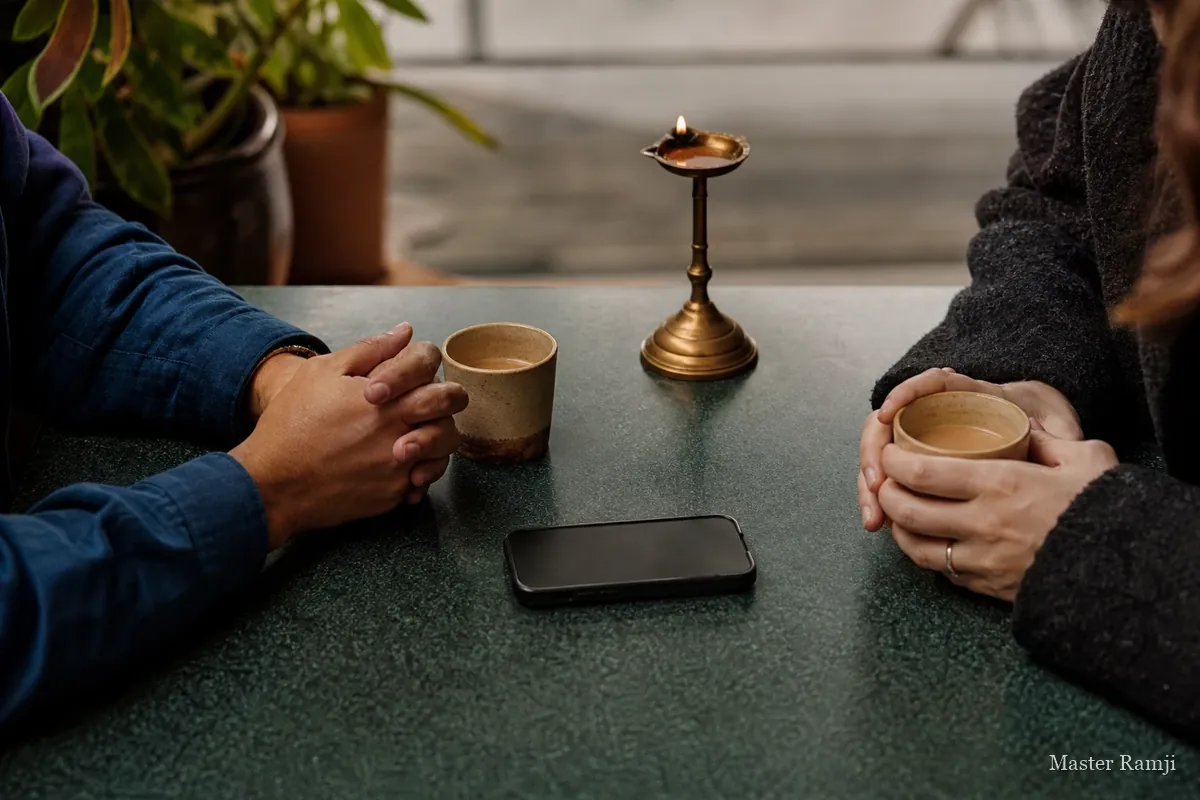
It takes about a minute. You type in two birthdays, press a button, and a website gives you a score out of 36 with a verdict in green or red. For many families, that is now how matching starts, often on a phone at the kitchen table.
There's nothing wrong with that as a first look. The problem starts when a free result gets treated as the final word. So let's look at what these calculators do well, where they fall short, and how to use them sensibly.
Key takeaways
- Calculators are good at arithmetic, and that's usually all they do.
- Two sites can give different scores because their settings and rules are different.
- Most leave out exceptions, the wider chart and timing.
- No tool, and no astrologer, can measure how two people will treat each other.
What does an online calculator do well?
Credit where it's due. Working out where the Moon was at a given moment is a job computers do very well, and they don't make the slips a person can make with printed tables. If your details are right and the settings are standard, a good tool will usually place the Moon correctly and add up the points properly.
So accuracy isn't really a question of bad maths. The question is what the tool was asked to calculate, and everything it was never asked to consider.
Why do two websites give different scores?
This puzzles people, and it can make a family suspicious of the whole exercise. There are several ordinary reasons.
Different starting points
Vedic astrology measures the zodiac using a correction called the ayanamsa. Several versions exist, and Lahiri is the most widely used in India. They differ only slightly, but a Moon sitting near the edge of a star can land on the other side of the line.
Different scoring tables
Parts of Vashya, Yoni, Graha Maitri and Gana are scored from tables, and these aren't identical everywhere. One or two points of difference is often just this.
Different exception rules
Some sites quietly reduce or restore points for certain exceptions. Others ignore them. Few tell you which approach they took.
Different traditions
A tool built around North Indian Ashtakoot won't give the same picture as one built around the South Indian porutham system. If your family follows one, a score from the other may not mean much to them.

What can go wrong with the details you enter?
A calculator trusts whatever you type. It can't ask, "Who told you that time?" Watch out for these:
- A rounded or remembered birth time. If the Moon changed star near your birth, a small error can alter several kootas together. Our guide to checking your birth details explains how to firm this up.
- The wrong place. Many sites autofill a city from the first few letters. Check that it picked the right one, as some town names are easily confused or have changed over time.
- Time zone and daylight saving. A Melbourne birth in summer and an Indian birth involve different clock rules. Check what the site assumed, and whether you can see it at all.
- Swapped partners. Parts of the scoring are written for a bride and a groom. Entering them in the wrong boxes can change the result.

What do automatic calculators leave out?
This is the bigger issue. A typical score ignores most of what a chart contains, because it only compares two Moon positions.
- The seventh house and its ruler, which tradition links with marriage
- Venus and Jupiter, which are commonly read for partnership
- The navamsa, a divisional chart often used in marriage readings
- Planetary periods, which show what stage each person is entering, and when
- Which points were lost, since many results lead with a total and a colour
- Context, such as a previous marriage, a health matter, or a family's own customs
Some sites add a Mangal dosha result, often as a simple yes or no. That can be especially misleading. A person may be flagged from one reference point and not from another, and the proper check also considers both charts together. Our article on Mangal dosha myths explains why this label causes so much trouble.
Why can a verdict do harm?
A number on a screen feels objective. It seems to come from nowhere and from no one, so it's hard to argue with. An astrologer can be questioned. A red banner saying "not recommended" can't.
That's a real cost when a family is already anxious. A score of 16 can end a good relationship before anyone has asked which points were lost or why. In the other direction, a score of 31 can make people less willing to look at a problem they can plainly see.
Neither result is a measure of the relationship. Horoscope matching is a tradition, and it hasn't been shown to predict whether a marriage will last.
Is your birth data safe on these sites?
People rarely think about this. Your full name, date, time and place of birth is personal information, and so is your partner's. Some free sites may exist mainly to collect contact details or sell paid reports. Before you enter anything, read the privacy policy and consider whether you need to use your real name. It's also fair to ask your partner first. The Office of the Australian Information Commissioner explains your privacy rights in Australia.

How should you use an online tool?
- Enter details you have checked. If you're unsure of a time, say so to yourself and treat the output as rough.
- Try a second tool. If the two disagree, your Moon may be near a boundary, and that's worth knowing.
- Look for the breakdown. Note the individual kootas and not only the total.
- Be wary of the upsell. If a free report warns of disaster and then offers a paid remedy, close the tab.
- Talk to each other. Money, children, faith and family expectations will matter far more than any output on a screen.
When is it worth going further?
You may not need to, and that's fine. If your family is content, there's no need to pay for more. It can be worth getting a person to look when the result is causing real conflict, when different sites disagree, or when there's a Nadi or Mangal concern on the page. A Guna Milan consultation goes through both charts and explains the reasoning, so you can question it, which is the one thing a calculator doesn't allow.
Please remember that it's still one opinion within a tradition. If you'd like to bring your online report and go through it together, get in touch.

Related service
Keep reading

Mangal Dosha Myths That Break Up Good Matches
A Manglik label can end a good match before anyone has looked at the charts. Here are the common Mangal dosha myths, and what a careful assessment involves.
Read article →
How Mangal Dosha Is Cancelled
The common Mangal dosha cancellation rules, why astrologers disagree about them, and the questions to ask before you accept any report that says severe or cancelled.
Read article →
Marrying a Manglik: What Families Should Know
Can a non-Manglik marry a Manglik? Yes. A practical guide for families: what to check first, how to run the conversation, and phrases for common worries.
Read article →Quick answers
What is Guna Milan?
Guna Milan is a traditional 36-point comparison of two people for marriage. See the eight factors it scores, what it leaves out, and how to read the result.
Read answer →What is a good Guna Milan score?
A good Guna Milan score is traditionally 18 or more out of 36. Here is what that threshold means, how bands vary, and why the total can mislead.
Read answer →Talk to Vijay Ramji
Tell us what you are facing. If a reading is unlikely to help, you will be told that plainly.