
The Eight Kootas Behind Your Guna Milan Score
Ashtakoot scores eight factors worth 36 points: Varna 1, Vashya 2, Tara 3, Yoni 4, Graha Maitri 5, Gana 6, Bhakoot 7 and Nadi 8. Each compares the two partners' Moon signs or birth stars. They are traditional categories, so they can't describe your character or predict your marriage.
A Guna Milan report often arrives as one number, such as 22 out of 36. That number is really the sum of eight smaller scores, and each one asks a different question about two people. Many families never see the breakdown, or they see it as a row of unfamiliar Sanskrit words.
Here are the eight Ashtakoot kootas explained in plain English: what each one looks at, how it earns its points, and where it runs out of road.
Key takeaways
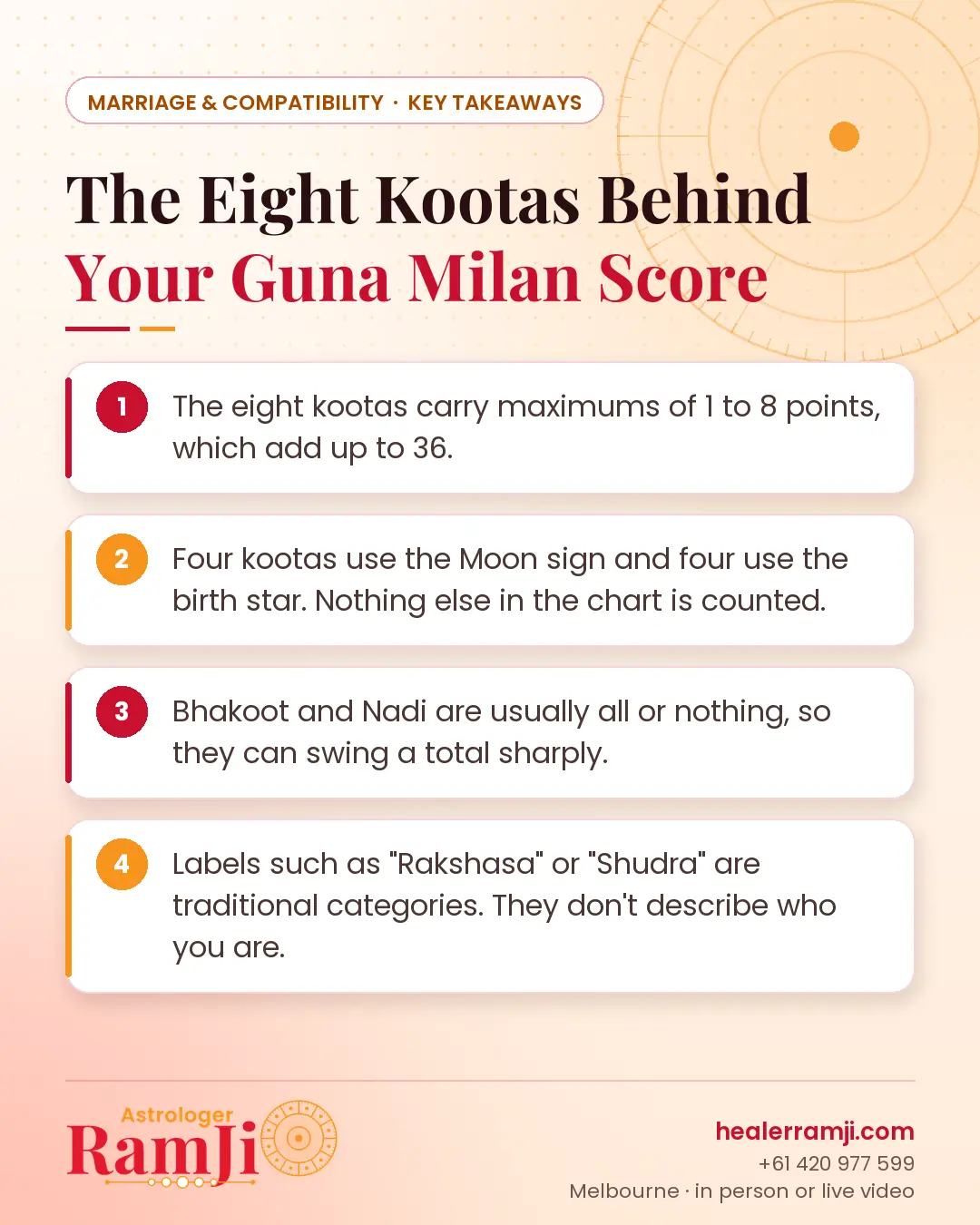
- The eight kootas carry maximums of 1 to 8 points, which add up to 36.
- Four kootas use the Moon sign and four use the birth star. Nothing else in the chart is counted.
- Bhakoot and Nadi are usually all or nothing, so they can swing a total sharply.
- Labels such as "Rakshasa" or "Shudra" are traditional categories. They don't describe who you are.
Where do the 36 points come from?
The maximums form a simple ladder: 1 + 2 + 3 + 4 + 5 + 6 + 7 + 8 = 36. In Vedic astrology, the higher rungs are the factors traditionally given more weight.
The inputs are narrow. Varna, Vashya, Graha Maitri and Bhakoot use each person's Moon sign, and together they're worth 15 points. Tara, Yoni, Gana and Nadi use each person's birth star, or nakshatra, and they're worth 21. Anyone whose Moon sits in the same place as yours would get the same result with the same partner, whatever their life looks like.

What does each koota measure?
1. Varna (1 point)
Varna sorts the twelve Moon signs into four groups named after the classical social classes. Water signs are called Brahmin, fire signs Kshatriya, earth signs Vaishya and air signs Shudra. Today it is usually read as outlook or temperament. The classic rule gives the point when the groom's group is equal to or higher than the bride's.
Two cautions apply. The group comes from your Moon sign and has nothing to do with your family's actual caste. And the rule reflects older ideas about husbands and wives, which many couples won't share.
2. Vashya (2 points)
Each Moon sign falls into one of five groups: four-legged animals, humans, water creatures, wild animals and insects. Sagittarius and Capricorn are split between groups, depending on where the Moon sits in the sign. Vashya is read as mutual influence, or how readily two people accept each other's lead. The same group scores 2, and other pairings score less.
3. Tara (3 points)
Count the stars from one partner's nakshatra to the other's, then divide by 9. A remainder of 3, 5 or 7 is treated as unfavourable. The count is done in both directions, and each favourable direction earns 1.5 points, so the only possible scores are 0, 1.5 or 3. Tara is traditionally linked with wellbeing and shared fortune.
4. Yoni (4 points)
Each of the 27 stars is paired with one of 14 animals. The same animal scores 4. Traditional enemies, such as cat and rat or snake and mongoose, score 0, and other pairs fall in between. Yoni is usually described as physical and intimate compatibility. That is a lot to ask of a star. Real intimacy rests on respect and honest conversation, which no chart can see.
5. Graha Maitri (5 points)
Each Moon sign has a ruling planet. Graha Maitri asks how those two planets regard each other in classical astrology: as friends, neutrals or enemies. Mutual friends score 5, mutual enemies score 0, and mixed pairings land in between. Mars rules Aries, for example, and Venus rules Taurus, so those two Moon signs are judged by how Mars and Venus relate. It is read as mental affinity and friendship.
6. Gana (6 points)
The stars divide evenly into three groups of nine: Deva, Manushya and Rakshasa. A common table gives 6 for the same group, 5 for Deva with Manushya, 1 for Manushya with Rakshasa and 0 for Deva with Rakshasa, though the tables vary a little. It is read as general temperament. A Rakshasa birth star doesn't make anyone a demon. One person in three would carry it if births were spread evenly across the stars.
7. Bhakoot (7 points)
Bhakoot looks at how far apart the two Moon signs are. Three relationships score 0: signs placed 2 and 12 from each other, 5 and 9, or 6 and 8. All others score the full 7. It is traditionally linked with family prosperity and wellbeing. Many astrologers recognise exceptions, for example when both signs share a ruling planet, so a zero here is a prompt to look further.
8. Nadi (8 points)
Each star belongs to one of three Nadi groups. Different groups score 8 and the same group scores 0. Tradition links this koota with health and children, which helps explain why it causes so much worry. Our page on Nadi dosha looks at its weighting and the exceptions in detail.
Why doesn't every family use this system?
Ashtakoot is especially common in North Indian practice. Many South Indian families use a ten-factor system known as porutham, which is scored differently. So a Tamil family and a Punjabi family in the same Melbourne suburb may mean quite different things when they talk about matching. Both are traditions, and neither has been shown to be the correct one.

Why does the mix of points matter more than the total?
Picture two hypothetical couples, each on 24 points. The first lost 8 on Nadi and 4 on Yoni. The second lost points spread across Tara, Yoni, Graha Maitri and Gana. Their reports show the same total, yet an astrologer would have a different conversation with each.
That doesn't mean there's an agreed ranking. Some astrologers look first at Nadi, Bhakoot and Gana because they carry the most points. Others care more about Graha Maitri, as friendship is what they think a long marriage leans on.
What should you ask when you see your breakdown?
- Are the birth details right? The Moon changes star about once a day, so a wrong birth time can change several kootas at once if it was near a boundary.
- Which kootas scored zero? Ask for each line, not only the total.
- Were exceptions applied? Many tools add up points and stop, as we explain in what online matching leaves out.
- What does the rest of the chart say? A Guna Milan consultation should also look at the seventh house, Venus, Jupiter, the navamsa and each person's planetary periods.

What can the eight kootas not tell you?
They can't tell you how someone handles money, anger or disappointment. They can't tell you whether you both want children, where you'll live, or how you'll treat each other's parents. Ashtakoot is a tradition, and no score has been shown to predict how a marriage will turn out. The nearest large test we know of looked at a different system: Swedish records from 1968 to 2001 showed no consistent link between Western zodiac compatibility and who married or divorced. A high total is no promise, and a low one isn't a sentence.
Use the breakdown as a starting point for better questions. If you'd like a shorter overview first, read what Guna Milan is. If you have a report and want to go through it line by line, please get in touch.

Related service
Keep reading
Nadi Dosha Explained
What Nadi dosha means, why it carries 8 of the 36 Guna Milan points, how astrologers assess exceptions, and why it isn't a genetic test.
Read article →
Why Online Horoscope Matching Is Not Enough
Free matching sites are quick, but how accurate are they? See what automatic calculators leave out, why two sites can disagree, and what to check next.
Read article →
Mangal Dosha Myths That Break Up Good Matches
A Manglik label can end a good match before anyone has looked at the charts. Here are the common Mangal dosha myths, and what a careful assessment involves.
Read article →Quick answers
What is Guna Milan?
Guna Milan is a traditional 36-point comparison of two people for marriage. See the eight factors it scores, what it leaves out, and how to read the result.
Read answer →What is a good Guna Milan score?
A good Guna Milan score is traditionally 18 or more out of 36. Here is what that threshold means, how bands vary, and why the total can mislead.
Read answer →Talk to Vijay Ramji
Tell us what you are facing. If a reading is unlikely to help, you will be told that plainly.