
Nadi Dosha Explained
Nadi dosha means both partners' birth stars fall in the same one of three Nadi groups, so the couple scores 0 of the 8 Nadi points in Guna Milan. Tradition links it with health and children. Exceptions are widely recognised, it is not a medical finding, and it doesn't decide a marriage.
Few phrases cause as much alarm in a matching report as "Nadi dosha". Often it is the single line that sends a family back to the phone, especially when someone adds that it affects children.
The nadi dosha meaning is simpler than the fear around it. This guide explains what it is, why it scores so heavily, how exceptions are weighed, and the one thing it definitely isn't.
Key takeaways
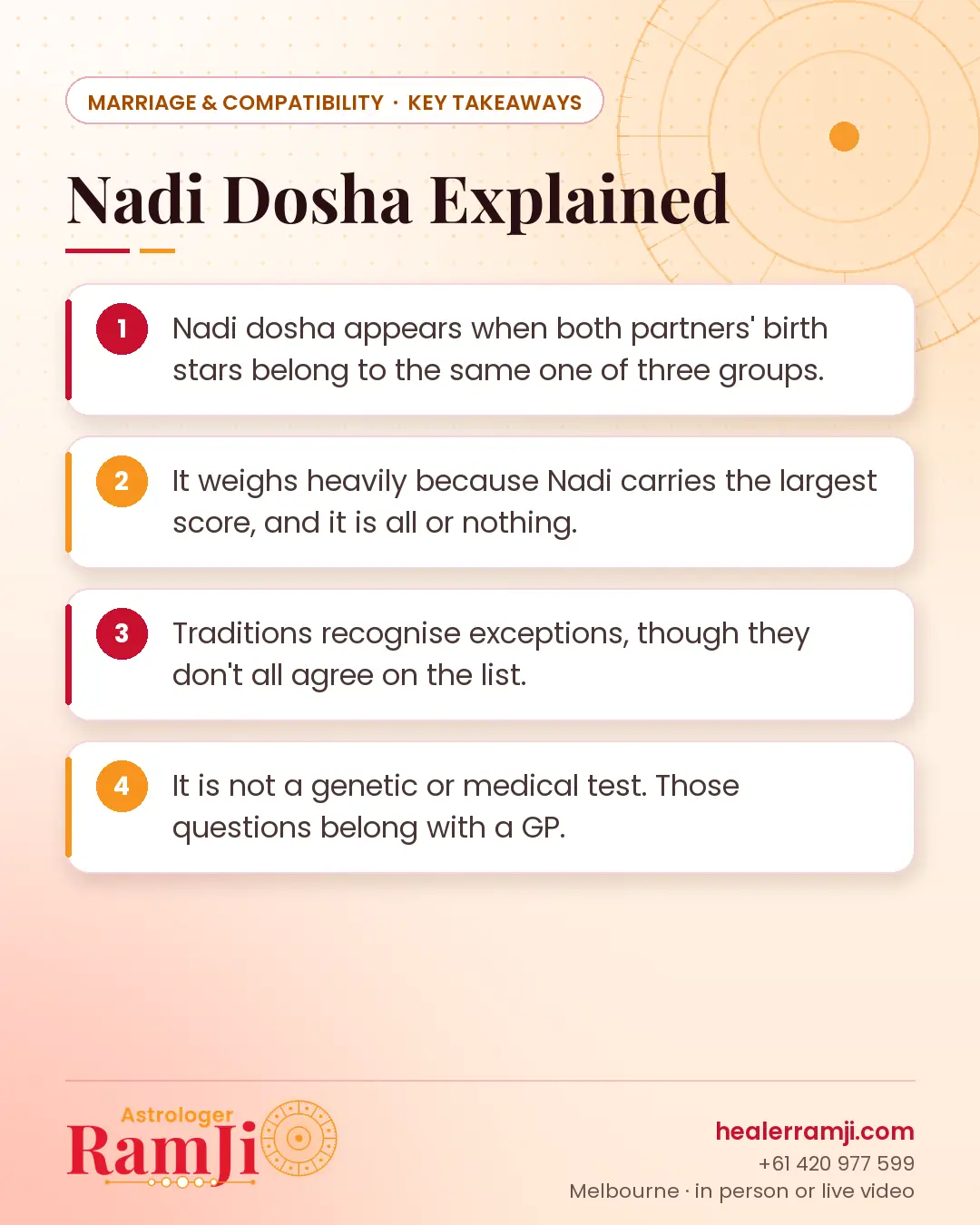
- Nadi dosha appears when both partners' birth stars belong to the same one of three groups.
- It weighs heavily because Nadi carries the largest score, and it is all or nothing.
- Traditions recognise exceptions, though they don't all agree on the list.
- It is not a genetic or medical test. Those questions belong with a GP.
What does Nadi dosha actually mean?
Nadi is the last of the eight kootas in Guna Milan. Each of the 27 nakshatras, or birth stars, is assigned to one of three groups. Tradition connects these with the three Ayurvedic constitutions:
- Aadi (Vata): Ashwini, Ardra, Punarvasu, Uttara Phalguni, Hasta, Jyeshtha, Mula, Shatabhisha, Purva Bhadrapada
- Madhya (Pitta): Bharani, Mrigashira, Pushya, Purva Phalguni, Chitra, Anuradha, Purva Ashadha, Dhanishta, Uttara Bhadrapada
- Antya (Kapha): Krittika, Rohini, Ashlesha, Magha, Swati, Vishakha, Uttara Ashadha, Shravana, Revati
If the two partners are in different groups, they receive all 8 points. If they're in the same group, they receive none, and that zero is what people call Nadi dosha.
Why does it score so heavily?
There are three reasons, and only the first is really about astrology.
It has the top score. Of the eight kootas, Nadi has the highest maximum, at 8 of the 36 points. Traditional texts put it last and weight it most.
It has no middle ground. Most kootas can give part marks. Nadi can't. One small fact about two birth stars moves the total by 8 points, which is enough to drag a comfortable score under the commonly quoted 18.
It touches what families fear most. Tradition links Nadi with health, constitution and children. In a family where those worries are already close to the surface, it takes very little for a table in a report to feel like a warning about future grandchildren.
Put the number in proportion, though. A couple with Nadi dosha can still score up to 28 of 36. And with nine stars in each of three groups, a third of all possible star pairings share a Nadi. That's simple arithmetic and not a survey, but it does show how ordinary this finding is.
How are exceptions assessed?
Traditional writers describe a number of exceptions, known as parihara. They don't all agree, so a careful astrologer will tell you which rule is being applied and how widely it's accepted. The ones you'll hear about most are:
- Same Moon sign, different birth star. Both Moons are in one sign but in different nakshatras. This is among the most commonly cited.
- Same birth star, different Moon sign. It can happen with stars that straddle two signs, such as Punarvasu.
- Same birth star, different pada. Each star has four quarters, called padas. Some astrologers treat a different quarter as easing the dosha, while others don't accept this.
- Friendly Moon sign rulers. Some sources reduce the concern when the planets ruling the two Moon signs are on friendly terms.
- Named stars. Some texts list particular nakshatras as exempt, but those lists differ from one text to another.
Because the rules differ, it's fair to ask whether an exception is doing real work or simply getting a family out of an awkward spot. It also works in reverse. A reader who says "there are no exceptions" is leaving out a good part of the tradition.
In what order should an astrologer look at it?
- Check the inputs. A nakshatra lasts about a day. If either person was born near a change of star, their Nadi may be different from what the report shows. Two sources for the birth time are better than one.
- Check which rule applies. Look at both Moon signs, both stars and both padas before calling it a dosha.
- Weigh it against the whole chart. A full Guna Milan reading also looks at the seventh house, the navamsa, Venus, Jupiter and each person's planetary periods.
- Say how confident the reading is. You should hear what is a traditional concern and what is simply unknown.
Does Nadi dosha mean there will be health problems or trouble having children?
No one can say that from a chart. There is no good evidence that sharing a Nadi affects health or fertility. You may read online that Nadi is really an ancient way of checking genetics or blood groups. That claim is unproven, and the groups come from the position of the Moon, not from anything in your body.
If you do have concerns about having children, there are real tests for that. Genetic carrier screening shows the chance of passing on certain inherited conditions, and most carriers have no known family history. A GP, obstetrician or genetic counsellor can talk through whether it suits you, and a GP is also the right person to ask about fertility. Please don't let a chart take the place of that conversation, and please don't treat a clear Nadi result as medical reassurance either.

Are remedies necessary?
Some families choose a prayer, mantra or charitable act because it gives them peace of mind. That's a personal choice, and a modest one is fine. It is not a medical step, and no ritual can promise a healthy family.
Be cautious if anyone says a costly puja is the only way a marriage can go ahead, or warns that your future children will suffer if you say no. That is pressure. Our guide to marriage remedies worth doing gives you some ways to judge an offer.
What should you tell your parents?
If your family is worried, take the fear seriously without accepting the conclusion. You might offer to get the exact details checked and to sit down together over a proper reading. Asking "which rule are we using, and what do other astrologers say?" can turn an argument into a discussion. You can also point them to a shorter answer on what Nadi dosha is.
In the end, the decision belongs to the two people getting married. If you'd like both charts read together with the exceptions spelled out, please get in touch.

Related service
Keep reading
Why Online Horoscope Matching Is Not Enough
Free matching sites are quick, but how accurate are they? See what automatic calculators leave out, why two sites can disagree, and what to check next.
Read article →
Mangal Dosha Myths That Break Up Good Matches
A Manglik label can end a good match before anyone has looked at the charts. Here are the common Mangal dosha myths, and what a careful assessment involves.
Read article →
How Mangal Dosha Is Cancelled
The common Mangal dosha cancellation rules, why astrologers disagree about them, and the questions to ask before you accept any report that says severe or cancelled.
Read article →Quick answers
What is Guna Milan?
Guna Milan is a traditional 36-point comparison of two people for marriage. See the eight factors it scores, what it leaves out, and how to read the result.
Read answer →What is a good Guna Milan score?
A good Guna Milan score is traditionally 18 or more out of 36. Here is what that threshold means, how bands vary, and why the total can mislead.
Read answer →Talk to Vijay Ramji
Tell us what you are facing. If a reading is unlikely to help, you will be told that plainly.