
What to Do When Parents Disapprove

If your parents disapprove of your partner, first work out what the objection is really about. Then choose an option that fits: give it time with a plan, arrange low-pressure meetings, find an ally, try family counselling, go ahead while keeping the door open, or pause. Nobody should be threatened or forced either way.
When your parents disapprove of your partner, it can feel like you have only two choices: give up the person you love, or lose your family. In practice, most people find more room than that. The options in between take patience, and none of them is painless, but they exist.
This page sets out those options. It is written for adults deciding their own relationships, and it assumes you want to keep your family in your life if you can.
Key takeaways
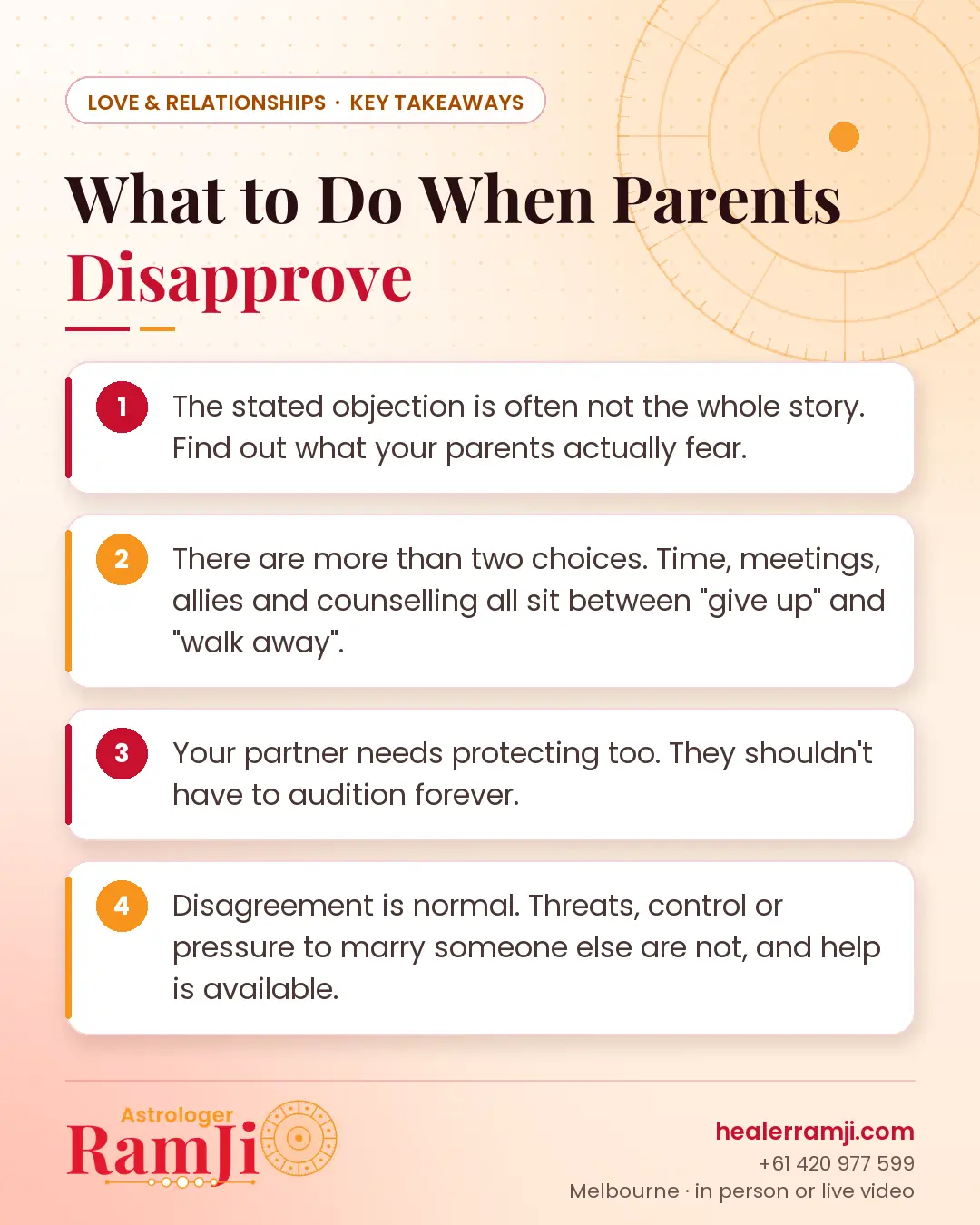
- The stated objection is often not the whole story. Find out what your parents actually fear.
- There are more than two choices. Time, meetings, allies and counselling all sit between "give up" and "walk away".
- Your partner needs protecting too. They shouldn't have to audition forever.
- Disagreement is normal. Threats, control or pressure to marry someone else are not, and help is available.
What is the objection really about?
Parents rarely say everything at once. It helps to listen for which of these sits underneath:
- The person. They have seen something in your partner's behaviour that worries them.
- The background. Caste, community, faith, language or country.
- The timing. Your studies, your age, your career, or an older sibling who isn't married yet.
- The community. What relatives will say, and how it will reflect on the family.
- The chart. A low matching score or a dosha.
- Loss. A fear that marriage outside the family's world means losing you.
Ask calmly, and more than once: "What worries you most?" Each answer points to a different response.
Is any part of it worth hearing?
This is the hardest question to ask honestly. Most objections based on caste or community don't say anything about your partner as a person. Concerns about behaviour are different. If your parents have noticed your partner checking your phone, cutting you off from friends or controlling your money, take a quiet moment to consider whether they have a point. Love can make those signs hard to see from the inside.
If the objection is only about background, you can disagree with it respectfully and still understand where it comes from.

What are your realistic options?
- Give it time, with a plan. Some parents soften over months, especially once the first shock passes. Waiting works better with an end point in mind, so it doesn't become indefinite. Agree with your partner how long you are both willing to wait, and what you will do then.
- Arrange low-pressure meetings. Prejudice often eases when a stranger becomes a person. A short meal, a festival visit or a cup of tea at a sibling's place can do more than a formal introduction where everyone feels judged.
- Find an ally. An aunt, an older cousin, a family friend or a respected elder may be heard where you aren't. Ask them to listen to your parents first, not to argue your case.
- Try family counselling. A trained counsellor can hold both sides in a way no relative can. Relationships Australia Victoria offers counselling for families. Parents who would never "see a therapist" will sometimes agree to "talk to someone neutral".
- Go ahead, and keep the door open. Some couples marry without full approval, then keep inviting, phoning and visiting. Some families come round with time, occasionally when grandchildren arrive, though some never do. This option means accepting that risk.
- Pause or end the relationship. That is a legitimate choice too, if you reach it yourself. Ending a relationship because you have doubts is very different from ending it because you were frightened into it.
Our article on how to tell your parents about your relationship covers the first conversation, if you haven't had it yet.
How do you look after your partner through this?
Your partner didn't choose this conflict. A few habits help:
- Don't pass on every hurtful thing your parents say. Share what your partner needs to know, not every word.
- Don't ask your partner to change their faith, name or habits to win approval unless they genuinely want to.
- Make decisions together, especially about timelines.
- Defend them clearly if they are insulted in front of you.
If your partner's family also disapproves, the same options apply on their side. Two families under pressure at once is a lot to carry, so be gentle with each other.
What if astrology is being used against the relationship?
A low Guna score or a Mangal dosha is sometimes raised as if it settles the matter. These are traditional ideas, and traditions differ on how much weight they carry. A chart can't forbid a marriage. Our short answer on whether a Manglik can marry a non-Manglik covers one common case. If your family values matching, a calm second opinion may lower the temperature, but nobody should change a result to suit either side.
If your parents are the ones struggling, our guide for parents of an intercaste couple may be worth sharing with them.
What protects your autonomy?
Being an adult in Australia means the choice of partner is legally yours. In practice, it also helps to have:
- Your own access to your bank account, phone and documents, including your passport
- A friend outside the family who knows what is going on
- Somewhere you could stay for a few nights if home became tense
None of this is about planning to leave. It simply means a hard conversation can't be used to trap you.
When does disagreement become unsafe?
Arguments, tears and silence are painful but common. These are different: threats to you or your partner, being kept at home, having your phone or passport taken, or being pushed to marry someone you don't want to marry.
- In immediate danger, call 000.
- For family violence or threats, call 1800RESPECT on 1800 737 732 at any hour.
- If you fear a forced marriage, here or overseas, My Blue Sky gives free and confidential help. Arranged marriages are legal, but each person must be free to say no.
- If you are 25 or younger, Kids Helpline is free on 1800 55 1800, at all hours.
Can talking it through with an astrologer help?
It can't change your parents' minds, and it shouldn't take sides. What guidance when family opposes a relationship can do is give you time to think aloud with someone outside the family: what you want to say, who might help, and what you would do if nothing changes. Your chart, and your partner's if they agree, can add a reflective lens on timing. It is a tradition, not proof, and the decision stays yours.
Vijay Ramji is based in Ascot Vale. Appointments are arranged in advance, sessions can be held by phone, WhatsApp or video, and what you share is confidential. If your family shares your phone, choose a safe time and device, then get in touch.
Related service

Keep reading
Forgiving Yourself After a Relationship Ends
Stuck blaming yourself after a relationship ended? A calm way to sort fair responsibility from self-punishment, with simple reflection and a quiet ritual of release.
Read article →
Indian and Chinese Family Traditions in Box Hill Couples
For Indian and Chinese couples in Box Hill: how Vedic charts and Bazi differ, how to raise them respectfully with both families, and what neither one can decide.
Read article →
Students in Clayton: Love, Family and Expectations
An international student in love in Clayton, with family pressure from home? How to think it through, what to share, and where to get real support.
Read article →Quick answers
Can astrology bring my ex back?
No, astrology can't make your ex come back, and nobody can honestly promise it. Here is what a reading can help with, and how to avoid costly promises.
Read answer →Is vashikaran ethical?
No. Vashikaran aims to control another person, which is unethical and is refused here. Why consent matters, and where to turn if you feel pressured or controlled.
Read answer →Talk to Vijay Ramji
Tell us what you are facing. If a reading is unlikely to help, you will be told that plainly.