
Using Spiritual Healing Alongside Medical Treatment
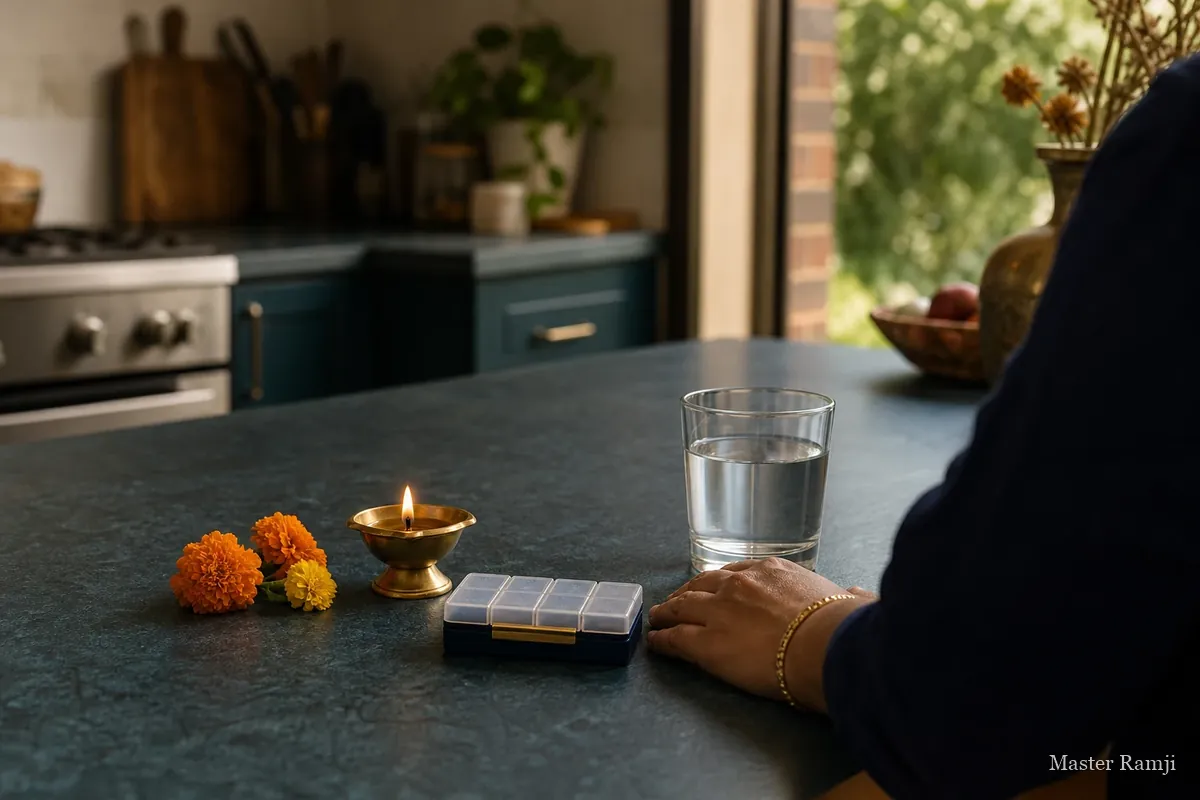
Spiritual healing alongside medical treatment can be a source of comfort, but it should only ever add to your care. Keep taking prescribed medication, keep your appointments, and tell your GP or specialist what you are doing. Any healer who tells you to stop treatment or hide it from your doctor is a warning sign.
Many people in Melbourne see no conflict between a specialist and a prayer. They take their tablets, go to their scans, and also light a lamp or ask for a blessing. For a lot of families, that is simply how illness is lived through.
That can work well, provided one rule holds firm. Healing goes alongside your treatment, never in its place. This page covers how to use spiritual healing alongside medical treatment safely, including how to raise it with your doctor and what to do if someone pushes you the other way.
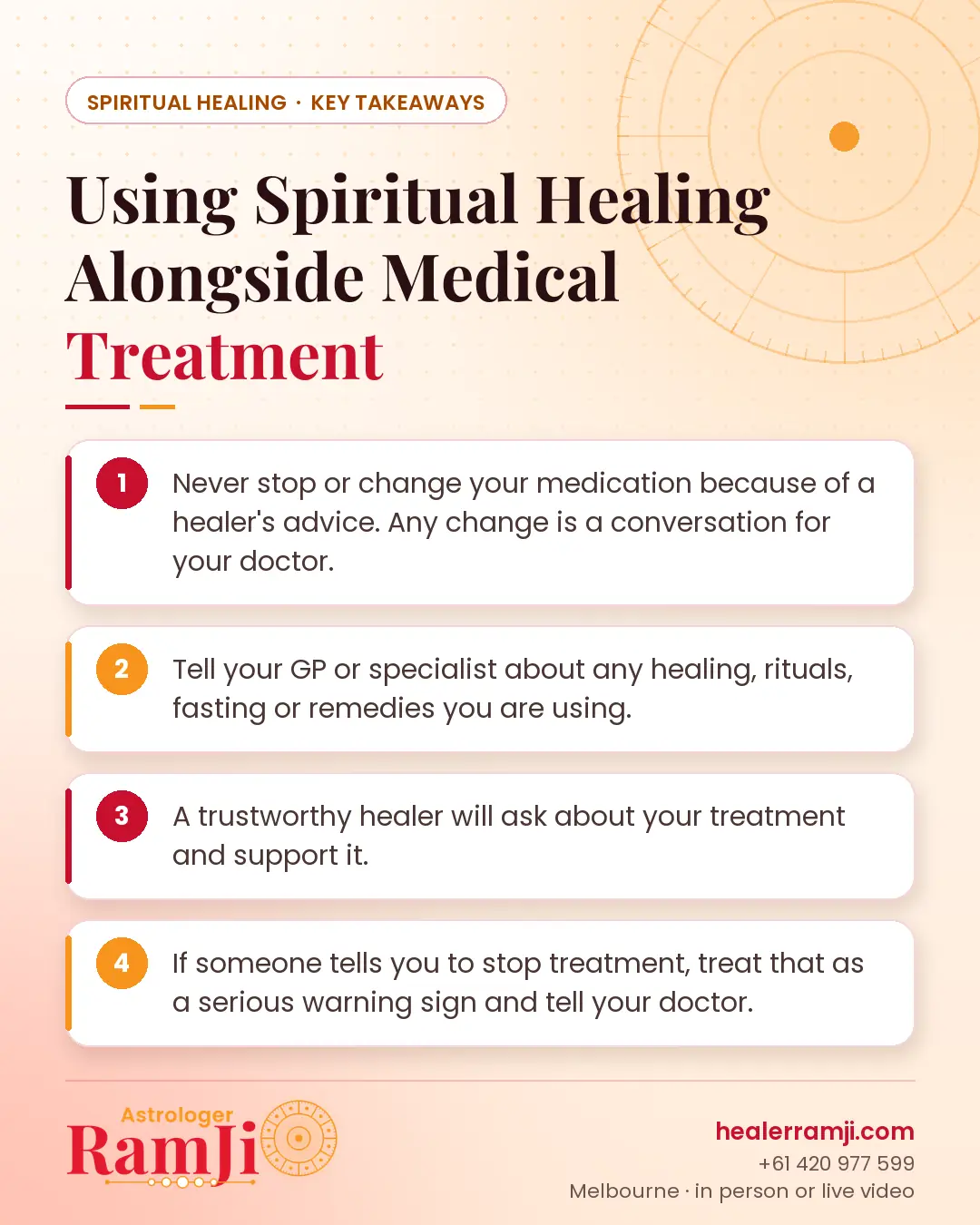
Key takeaways
- Never stop or change your medication because of a healer's advice. Any change is a conversation for your doctor.
- Tell your GP or specialist about any healing, rituals, fasting or remedies you are using.
- A trustworthy healer will ask about your treatment and support it.
- If someone tells you to stop treatment, treat that as a serious warning sign and tell your doctor.
What does "alongside" really mean?
There is a useful distinction here. Cancer Council Australia describes complementary therapies as those used with conventional treatment, and alternative therapies as those used instead of it. It does not recommend alternative therapies, and warns that they may cause harm to people who use them in place of medical treatment. Its examples don't include energy healing, but the principle carries across.
Spiritual healing should only ever sit in the first group. In practice, that means your medical plan stays exactly as your doctors set it, and prayer, mantra or a healing session is added around it for comfort and meaning. It is not treating your condition. Our page on what the evidence shows explains why we say that.
Why should you never stop medication?
The Better Health Channel, run by the Victorian Government, puts it plainly: "Never stop taking prescribed medications, or change the dose, without first discussing with your doctor."
There are good reasons for this:
- Some medicines can cause problems if they are stopped suddenly. Your doctor may need to reduce them slowly, or not at all.
- Feeling better might mean the medicine is working. Stopping it because you feel well can undo that.
- Many conditions, such as high blood pressure, can cause harm without any symptoms you would notice.
- Delay can matter. A condition that was manageable early may be harder to treat later.
This applies to mental health treatment as much as anything else. Antidepressants, therapy and psychiatric care are not signs of weak faith. Please don't let anyone tell you otherwise.
How do you tell your doctor?
Many people keep quiet because they fear being judged or laughed at. Most clinicians simply want to know what you are doing so they can keep you safe. You don't have to defend your beliefs. Something short will do:
- "I want you to know I'm also seeing a spiritual healer. I'm not changing anything you've prescribed."
- "My family has arranged a ritual that involves fasting. Is that safe with my medication?"
- "I've been given this powder and tonic. Can you check them before I take anything?"
The last two matter most. Prayer on its own doesn't interact with anything, but herbs, powders, oils and fasting may. The Better Health Channel notes that some complementary therapies can cause side effects or interact with conventional medicines. Take the packets to your appointment, and speak to your pharmacist too. If talking about this in English is hard, ask the clinic about an interpreter.

What should you tell your healer?
You don't owe a healer your full medical history, but a few things are useful for them to know:
- That you are under medical care, and for what, in broad terms
- Any upcoming surgery or treatment dates, so nothing clashes
- Anything your doctor has told you to avoid, such as fasting
- Whether you feel up to a session today
A healer should not interpret your test results, comment on your dose or offer an opinion on your diagnosis. If you ask and they answer anyway, that is a problem. A good one will say, "That's a question for your doctor."
What are the warning signs in a healer?
Be careful if anyone does the following:
- Tells you to stop, reduce or delay medication, surgery or therapy
- Asks you to keep the healing secret from your doctor or family
- Says treatment is "blocking" the healing, or that doubt will ruin it
- Blames your illness on your faith, your past or your family
- Promises a cure, or asks for rising payments to keep going
- Gives you unlabelled substances to swallow
If this has happened to you, tell your doctor what was said. In Victoria, the Health Complaints Commissioner runs a free, impartial complaints service for health services, and can tell you whether it is able to help. Our guide to choosing a healer safely has more.
What if your family is pushing you?
Pressure doesn't always come from a healer. It may come from a parent or an elder who loves you and is frightened. They may urge you to try a ritual first, or to skip the next round of treatment until after an auspicious date.
You can honour the love without following the advice. Try saying, "I'm happy to do the prayers, and I'm also going to my appointment." If it is hard to hold that line, ask your treating team for support. Some hospitals have social workers or spiritual care staff who help with exactly this sort of family conversation, so it is worth asking.
If you are the relative, please remember that it is the patient's decision. Offer prayer as a gift, without any conditions attached.

How can you fit healing around treatment?
A few practical habits help:
- Check with your care team before any fast, or before bringing a ritual item into a hospital.
- Keep sessions gentle and short on days you feel unwell. Phone or video can spare you the travel.
- Choose simple practices you can do lying down, such as a quiet mantra or slow breathing.
- Never miss a medical appointment to attend a spiritual one.

When should you get medical help straight away?
If you have a new or worsening symptom, contact your doctor rather than waiting for a session. For advice at any hour, call healthdirect on 1800 022 222. In an emergency, call 000. If you are in distress or thinking about harming yourself, Lifeline is available on 13 11 14.
Where does spiritual healing fit?
For some people, it offers a calm hour and a way to feel connected during a frightening stretch of life. That can be worthwhile on its own terms, and it doesn't need to be more than that. Our short answer on replacing a doctor is clear: it can't.
Our energy healing sessions and spiritual support in hard times are offered on this basis, as spiritual practice and never as a change to your medical care. If that sounds right for you, please get in touch.

Related service

Keep reading
How Distance Healing Sessions Are Run
What a distance healing session involves: how it is set up by phone or video, what to ask beforehand, what privacy to expect, and the limits of remote work.
Read article →
The Seven Chakras Explained Simply
The seven chakras explained in plain language: what each name means, where tradition places it, which parts are old and which are modern, and what chakras cannot do.
Read article →
Chakra Myths You Can Safely Ignore
Seven chakras, rainbow colours, blocked chakras and crystals: common chakra myths set against what the Indian tradition actually taught, in plain language.
Read article →Quick answers
What is energy healing?
Energy healing rests on the belief in a life force that can be guided. Here is what a session involves, and what the evidence does and doesn't show.
Read answer →Can spiritual healing replace a doctor?
Spiritual healing can't replace a doctor or prescribed treatment. Here is how to keep your faith alongside medical care, and which warning signs to watch for.
Read answer →Talk to Vijay Ramji
Tell us what you are facing. If a reading is unlikely to help, you will be told that plainly.