
Shift Work Routines for Spiritual Practice

A spiritual routine for shift workers works best when it follows your roster, not the clock. Plan a short practice for each type of shift, anchor it to waking up, and protect sleep first. Weekly observances can move to your day off. Tradition links Saturn with patient, steady effort, which suits a small practice kept up over time.
Most advice about daily prayer assumes a fixed day. Wake at dawn, pray before breakfast, light a lamp at dusk. If you work nights one week and early starts the next, that advice can leave you feeling as if you are always failing.
This article offers a different approach. Instead of one routine you can't keep, you build a few small ones that match the shifts you actually work.
Key takeaways
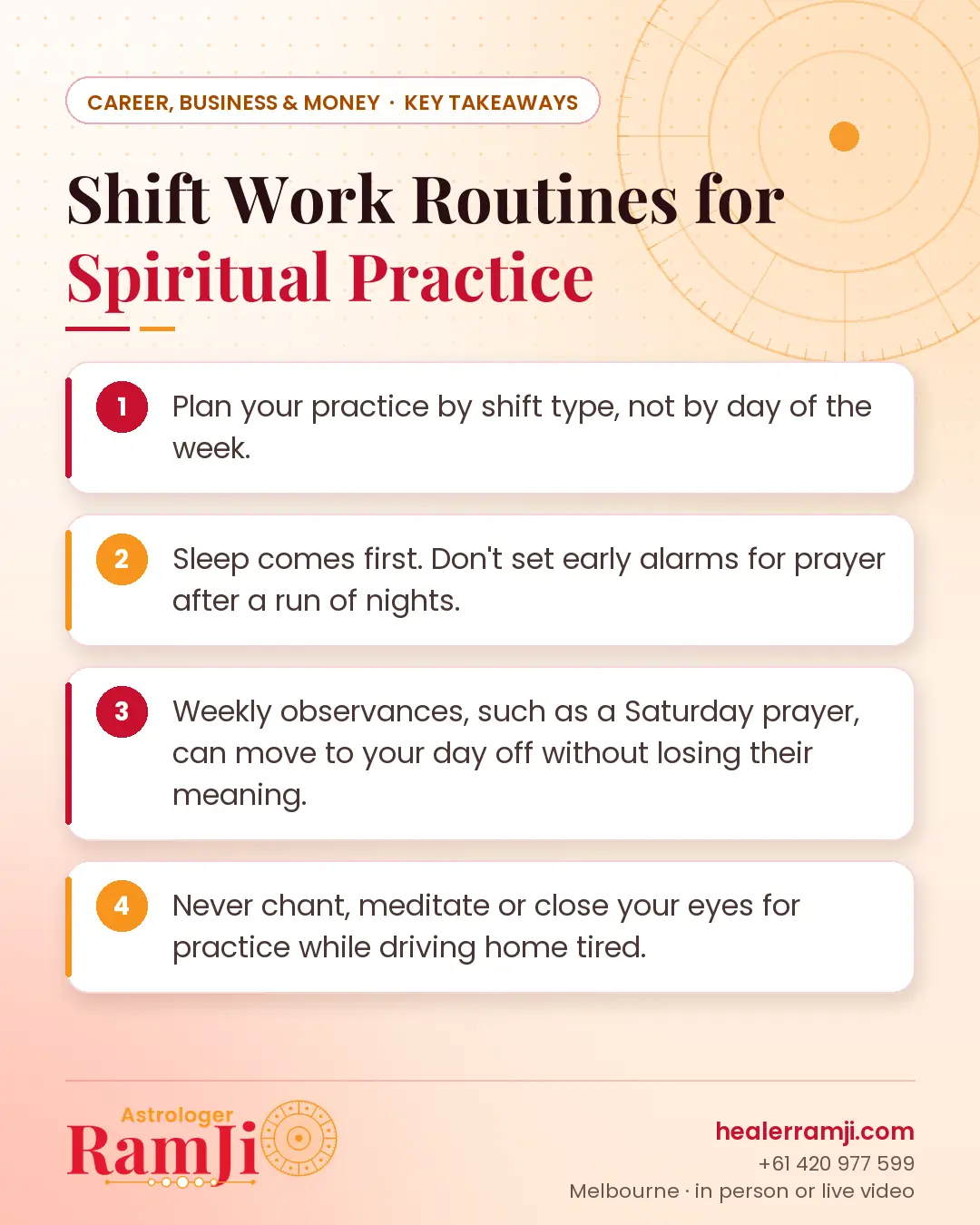
- Plan your practice by shift type, not by day of the week.
- Sleep comes first. Don't set early alarms for prayer after a run of nights.
- Weekly observances, such as a Saturday prayer, can move to your day off without losing their meaning.
- Never chant, meditate or close your eyes for practice while driving home tired.
Why is Saturn linked with shift work?
In Vedic astrology, Shani, or Saturn, is one of the nine navagraha and gives its name to Saturday, Shanivara. Saturn is traditionally associated with labour, discipline, endurance and service. Many people on hard rosters feel a natural connection to those themes.
There is a useful lesson in that link. Saturn is said to reward what is steady and unglamorous. A short practice kept up through tired weeks fits that idea far better than an ambitious routine that collapses by Wednesday. You don't need to believe your roster is caused by your chart to find that encouraging.
How do you plan practice around a rotating roster?
Look at your roster and sort your days into four types. Then give each one its own practice.
- Day or early shifts. A lamp and one short prayer before you leave. A minute of silence when you get home.
- Afternoon or evening shifts. Your fullest practice of the working week, in the morning when the house may be quiet.
- Night shifts. The core only. A short mantra on waking, whatever the hour, and a quiet word of thanks before you sleep.
- Days off. Time for a longer puja, a temple visit, a family aarti or reading.
Write these on a card and stick it where you dress for work. When you check your roster, you will know what each day asks of you.

What about the change-over days?
The hardest days are often the ones when you switch from nights to days, or the first day off after a run of nights. Your body is out of step and your mood may be low. On those days, the most spiritual thing you can do may be to rest.
Keep a "minimum practice" for these days. It might be one breath with your hands joined, or one line of a prayer. It still counts. If guilt about doing less keeps returning, remember that most traditions value sincerity over length.
How do you protect sleep without dropping practice?
Sleep is not a lesser priority than prayer. The Better Health Channel notes that shift workers get, on average, two to three hours less sleep than other workers, and that night work raises the risk of work and road accidents. healthdirect says most adults need about seven to nine hours of sleep, and suggests sleeping before a shift and keeping the bedroom dark and quiet.
So a few rules help:
- Never cut sleep to fit in a longer practice.
- Don't set an alarm for dawn prayers after a night shift. Pray when you wake.
- Keep any practice before sleep short and calm. Avoid bright screens for prayer apps if they keep you awake.
- If you are struggling to stay awake at work or on the road, see your GP.

Can you practise at work or on the way home?
Silent repetition of a mantra on a break, or a minute of slow breathing before you eat, can work well. Some people keep a small mala in a pocket, or use their fingers to count.
Don't practise anything while driving. A drive home after nights is already risky, and closing your eyes or drifting into a chant can make it worse. If you want to sit with a mantra before driving, do it once you have parked, or wait until you are home. If you are drowsy, don't drive at all. Pull over, or arrange a lift.
What if your weekly observance falls on a work day?
Many families keep a day of the week for a particular deity or planet, such as Saturday for Shani or Hanuman, Monday for Shiva or Thursday for Jupiter. If your roster keeps landing on that day, you have choices:
- Keep a very short form on the day itself, such as one mantra on waking.
- Move the fuller observance to your next day off.
- Ask your priest or an elder what your family tradition allows. Many are more flexible than people expect.
Fasting on a working night shift needs extra care. If you lift, drive or operate machinery, a lighter fast is safer. Check with your GP first if you have diabetes, take regular medication or are pregnant.
How do you keep a link with community?
Shift work can cut you off from festivals and weekend temple life. Look for quieter weekday visits on your days off, when the temple may be calmer anyway. Ask whether your temple streams any regular aarti or bhajans. Keep in touch with one person from your community, even by message, so you don't drift away entirely.
If your household works opposite rosters, share the home practice. One person can light the morning lamp and another the evening one.
Is Saturn telling you to change jobs?
Some people read a hard roster as a sign from their chart. It's worth being careful. Our piece on Saturn and the slow years at work looks at telling patient progress from being stuck. A chart can offer a frame for reflection. It isn't evidence about your job, and sleep, safety and money are good reasons to act whatever a reading says.
If you are weighing up the next few years, a career timing reading sorts periods into growth and consolidation for reflection only. For a short daily practice built around your roster, a personal mantra remedy plan can help. For more short practices, see meditation for people with no spare time. Sessions can be held by phone, WhatsApp or video, and appointments are arranged in advance, so have your roster handy when you book. To arrange one, get in touch.
Related service

Keep reading

Is It the Right Time to Ask for a Promotion?
Thinking about when to ask for a promotion? How astrology timing can help you prepare your case, and why your results and your employer's calendar come first.
Read article →
Starting a Side Business While Employed
Thinking of starting a side business while you keep your job? Check your employment contract and registrations first, then choose an astrology timing for launch.
Read article →
Starting a Business in Dandenong: Timing and Practical Steps
Planning a shop on or near Foster Street? How to start a business in Dandenong with council and lease checks first, and a muhurat that fits the real dates.
Read article →Quick answers
Can astrology help me choose a career?
Astrology can prompt useful questions about work, but it can't pick your career. Here is what a chart may suggest, its limits, and who to ask for real advice.
Read answer →Which house shows career in Vedic astrology?
In Vedic astrology, the tenth house is the main house of career. Here is what else a reader looks at, where views differ, and what a chart can't tell you.
Read answer →Talk to Vijay Ramji
Tell us what you are facing. If a reading is unlikely to help, you will be told that plainly.