
Lakshmi Puja for Business Owners
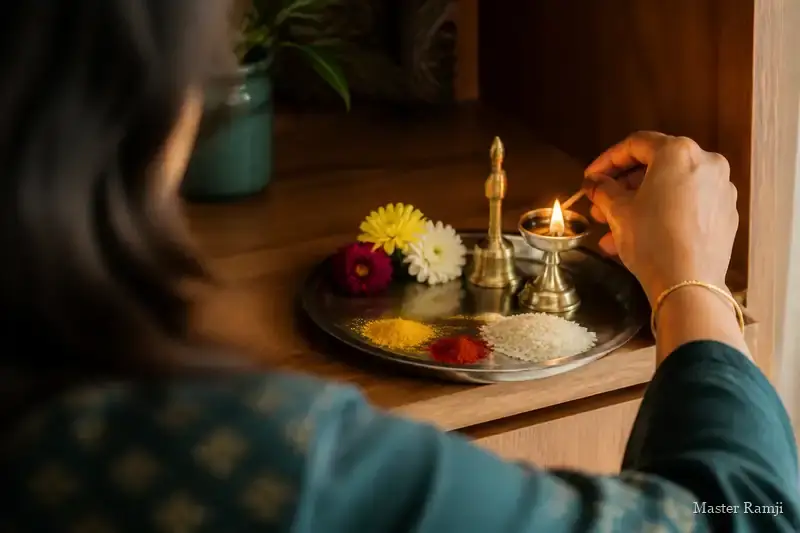
Lakshmi puja for business is a Diwali rite in which owners honour Ganesh and Lakshmi and give thanks for their work, often placing account books or tools before the deities. In Australia it can be held at the shop after hours or at home. It expresses gratitude and hope, and can't promise profit.
For many business families, Diwali is the most important night of the working year. The shop is cleaned, the books are brought out, and the owner sits before Ganesh and Lakshmi to give thanks for the year that has passed and pray for the one ahead.
Running a business in Australia changes some of the details. The financial year doesn't start at Diwali, the shop may be in a shopping centre with strict rules, and staff may come from many faiths. This page looks at how owners keep Lakshmi puja for business meaningful within those limits.
Key takeaways
- Lakshmi puja is held on the new moon of Diwali, traditionally in the evening, with Ganesh honoured first.
- Many business families place account books, pens or tools before the deities. In Australia this is symbolic, as the tax year runs from July to June.
- You can hold the puja at the premises after trading hours, or at home with a symbol of the business.
- Check your lease and smoke detectors before lighting anything at work, and keep staff involvement voluntary.
What is Lakshmi puja, and why do business owners keep it?
Lakshmi Puja falls on the amavasya, or new moon, of Diwali, in the month of Ashvin or Kartika depending on which calendar a family follows. Lakshmi is honoured as the goddess of prosperity and good fortune, and Ganesh, the remover of obstacles, is usually worshipped first. Lamps, flowers, sweets and coins are common offerings, and in many homes account books and ink are placed near the deities too.
For traders, this makes the evening a natural moment to look back over the year's work and give thanks for it. Many Gujarati trading families keep chopda pujan on this night, worshipping new account books before the Gujarati new year, which usually begins the next day. Other business communities have customs of their own, so ask an elder what your family did.
How does it fit an Australian business year?
In India, some families open new books at Diwali because their trading year turns over then. In Australia, your financial year runs from July to June, and your records follow that. So the books placed before Lakshmi are now mostly symbolic.
Owners adapt in simple ways:
- A new notebook for the year's hopes and goals, marked with "Shubh Labh" or a swastika on the first page, as your family does
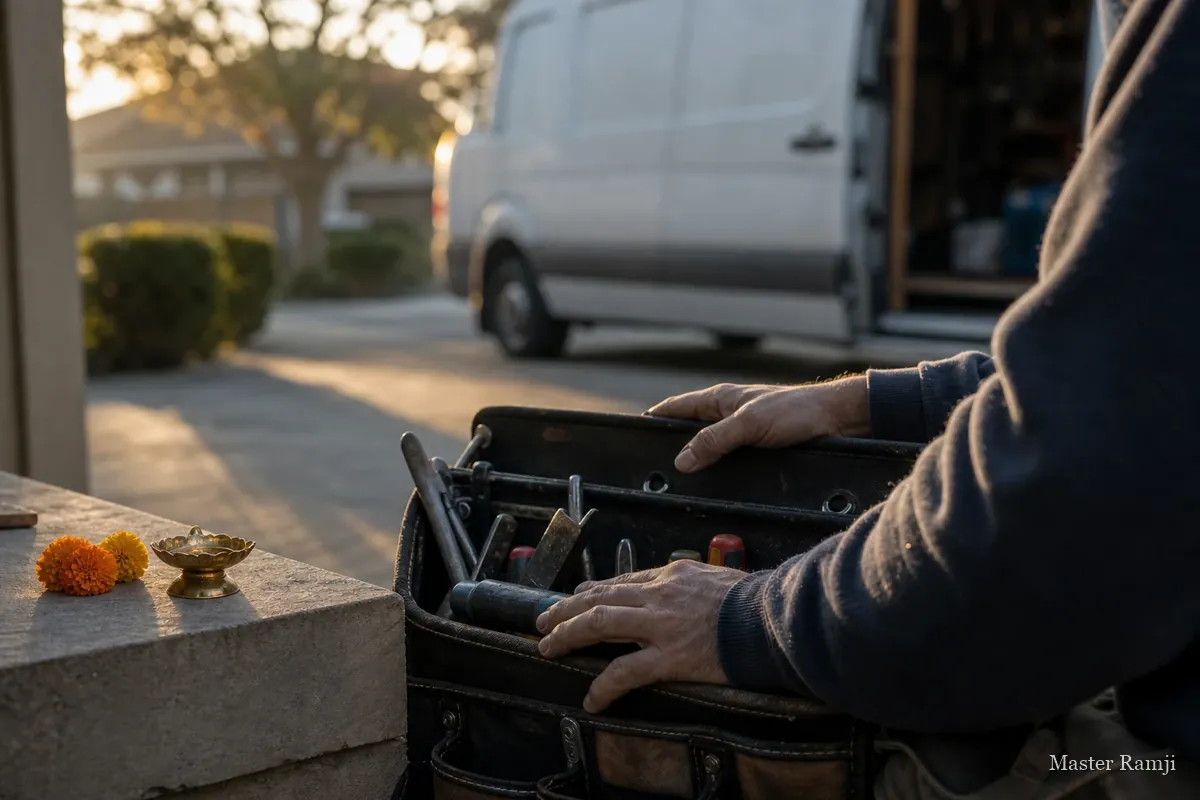
- The shop keys, a receipt book, a set of tools or the laptop you run the business from
- A copy of your first invoice, business registration or lease
Don't mark, alter or write blessings in your actual financial records. Keep those exactly as your accountant advises.

Should you hold it at the shop or at home?
Both are common, and both are fine.
At the premises suits owners with their own shopfront or office. Hold it after closing, when the floor is clear and you can take your time. Ask your landlord or centre management first if you plan to light lamps or incense.
At home suits owners in shared buildings, shopping centres, warehouses with sprinklers, or anyone working from a home office. Bring something from the business to the home shrine, and pray for the work and the people in it.
Some families do a short prayer at the shop in the morning and the full puja at home in the evening.
What does a simple business Lakshmi puja involve?
Follow your own family's practice first. If you have none, a modest outline looks like this:
- Clean the premises properly, including the entrance and counter.
- Set a clean cloth on a stable table with images of Ganesh and Lakshmi.
- Place your books, keys or tools beside them, with a few coins and some sweets.
- Pray to Ganesh first, then to Lakshmi, in whatever words you know.
- Sing or play an aarti.
- Share prasad with family, and with any staff who would like some.
Many owners also give to charity at this time, or thank their staff in a way that suits the business. Gratitude is at the heart of the rite.

What about staff and customers?
Your staff may be Hindu, of another faith or of none. Invite them warmly if you like, but make clear that joining in is optional, and never treat it as part of their job. Keep a display at the counter simple and tidy. A rangoli at the entrance or a few battery lamps in the window can share the festival with customers without making anyone uncomfortable.
How do you keep a business puja safe?
Commercial buildings have alarm systems that react quickly. Fire Rescue Victoria lists smoke from candles and incense among common causes of false alarms, and says the owner of the alarm system can be charged a fee, depending on how the alarm is assessed. Practical steps:
- Keep lamps and incense well away from smoke detectors, and never cover or disable one.
- Follow the CFA's candle safety advice: a stable, hard surface at least one metre from anything that can burn, and never left without someone there.
- Keep flames away from stock, packaging and paper.
- Put everything out before you lock up. Don't leave a diya burning overnight in an empty shop.
- Use battery lamps in windows and displays.
When should the puja be held?
Lakshmi puja is traditionally done in the evening window after sunset on Diwali. That window is calculated from local sunset, so a time printed for an Indian city won't match your suburb. Our guide to Diwali puja timing in Melbourne explains why. If you are also planning an opening or launch, a business launch muhurat works around your real deadlines.
What can Lakshmi puja not do?
It is an act of faith and gratitude. It can't promise profit, repair cash flow or replace an accountant, and anyone who says a costly puja will guarantee a good year is selling something. If trade is the worry, our article on whether slow trade is about energy or your business plan is a better first step.
For a shop opening rather than a festival, see holding an opening puja at your shop. Vijay Ramji is based in Ascot Vale, appointments are arranged in advance, and sessions can be held by phone, WhatsApp or video. Fees are stated before paid work. To plan your Diwali at work, get in touch.
Related service
Keep reading

Shift Work Routines for Spiritual Practice
Keeping prayer and practice going on a rotating roster: plan by shift block, protect your sleep, move weekly observances, and why Saturn is linked with steady work.
Read article →
Is It the Right Time to Ask for a Promotion?
Thinking about when to ask for a promotion? How astrology timing can help you prepare your case, and why your results and your employer's calendar come first.
Read article →
Starting a Side Business While Employed
Thinking of starting a side business while you keep your job? Check your employment contract and registrations first, then choose an astrology timing for launch.
Read article →Quick answers
What is a business muhurat?
A business muhurat is a date and time chosen by Hindu tradition to begin a venture. Here is how one is chosen, what it can't do, and how to fit your paperwork.
Read answer →Can astrology help me choose a career?
Astrology can prompt useful questions about work, but it can't pick your career. Here is what a chart may suggest, its limits, and who to ask for real advice.
Read answer →Talk to Vijay Ramji
Tell us what you are facing. If a reading is unlikely to help, you will be told that plainly.