
Farm and Seasonal Work in Shepparton: Planning Ahead
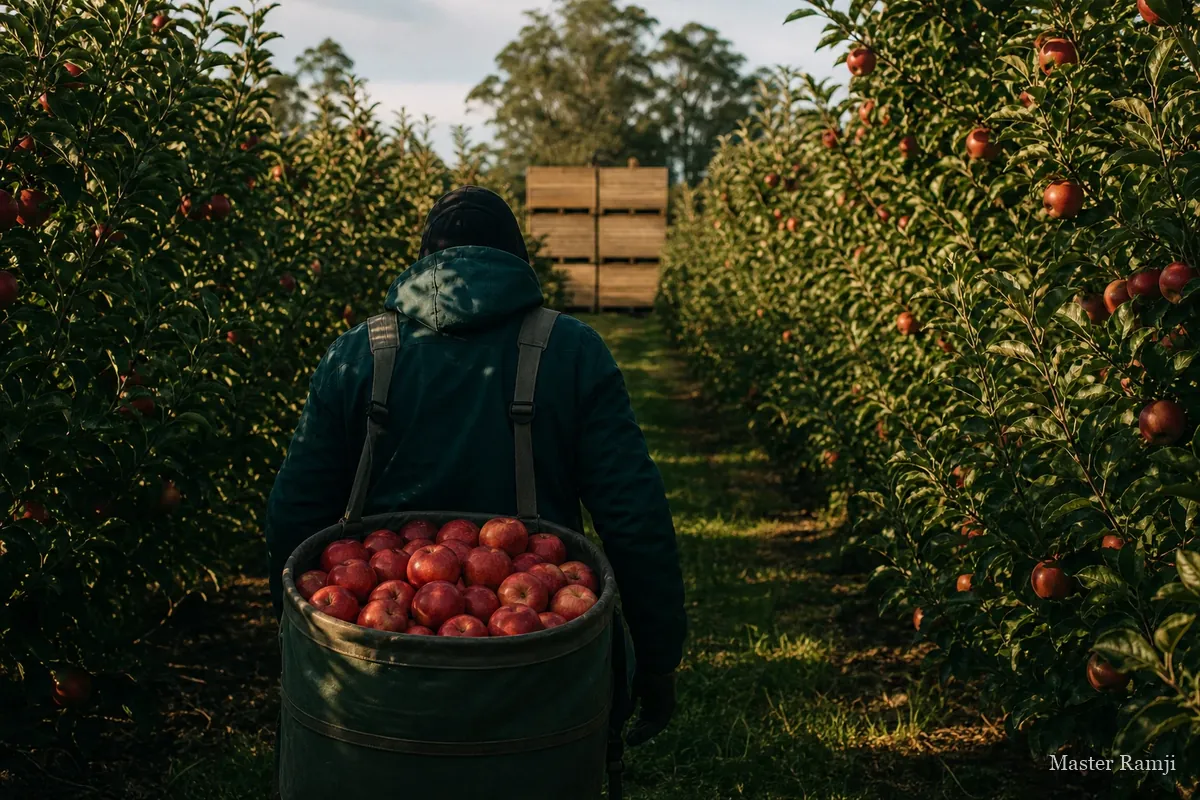
Seasonal work in Shepparton follows the fruit harvest, so income often peaks over summer and autumn and thins out in the colder months. Budget on your lowest months, check your pay against the Horticulture Award, keep your own records of hours and piece rates, and use quieter months for training. Astrology offers a timing lens, never financial advice.
Shepparton sits in the Goulburn Valley, where the Goulburn and Broken Rivers meet, about 160 km north of Melbourne, or nearer 180 km by road. Victorian Places traces how irrigation in the early twentieth century turned the district into fruit country. Orchards spread across Shepparton East, and the city became home to the Shepparton Preserving Company, known as SPC, and Ardmona.
That history still shapes local work. Many people here pick, pack, prune or drive through the harvest, then look for other work when it ends. If that's your life, the hard part is often not the work itself. It's the swing between busy months and lean ones, and the question of whether to stay with it or move on. This article is about planning for both.
Key takeaways
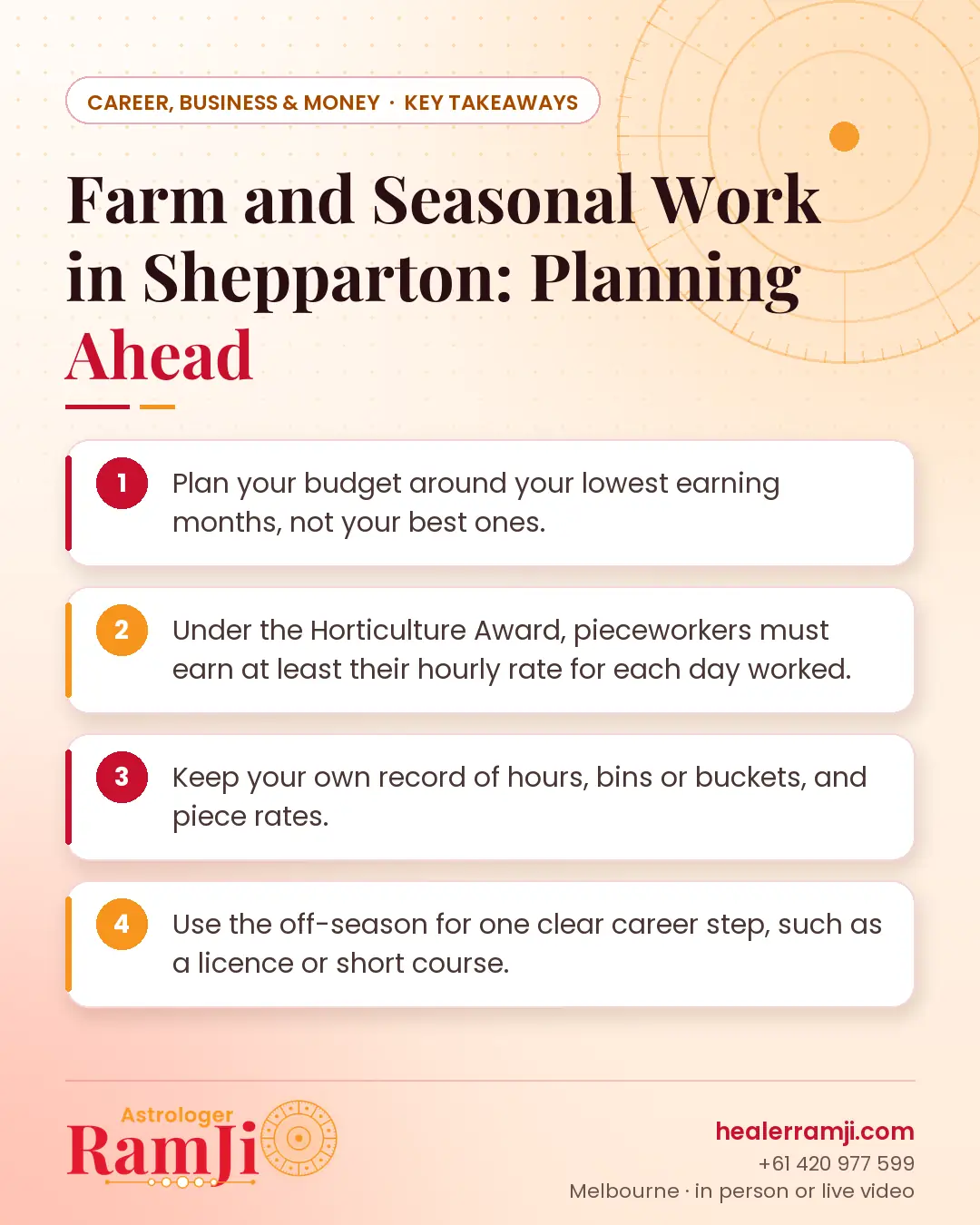
- Plan your budget around your lowest earning months, not your best ones.
- Under the Horticulture Award, pieceworkers must earn at least their hourly rate for each day worked.
- Keep your own record of hours, bins or buckets, and piece rates.
- Use the off-season for one clear career step, such as a licence or short course.
Why does seasonal work make planning so hard?
Harvest work in the Goulburn Valley usually starts in early summer with cherries and stone fruit, and runs into autumn with apples and pears. Exact timing changes with the weather and the variety, so no two years look quite the same. For workers, that means a run of long weeks and good pay, followed by a drop.
Long harvest days also leave little energy for thinking ahead, so planning tends to get pushed to the off-season, when money is already tight. The risk is that spending rises to match the busy months. A car loan, a new phone plan or money sent home can feel easy in February and heavy in July. Good planning starts from an honest question: what do I earn in my quietest month?
How should you budget around uneven income?
- Find your floor. Look back over the last year and note your lowest month. Build fixed costs, like rent and loan repayments, around that figure.
- Pay yourself a steady amount. Some people put all pay into one account and move a set weekly amount into their everyday account. The rest becomes a buffer.
- Set aside money for the gap. Decide in advance how much of each harvest pay goes towards the winter months.
- Plan family transfers. If you send money overseas, agree on an amount your family can rely on all year, rather than large sums only at harvest.
The government's Moneysmart website has free budgeting tools that help with irregular income. If debts are already piling up, the free National Debt Helpline can connect you with a financial counsellor. Astrology can't tell you what to buy, borrow or invest. Why astrology should never pick your investments explains that line in more detail.

Are you being paid correctly?
Many picking and orchard jobs are covered by the Horticulture Award 2020, published by the Fair Work Ombudsman. Some roles, such as certain packing or transport jobs, may fall under a different award, so check which one applies to you. If yours is the Horticulture Award, a few points are worth knowing:
- Piece rates have a floor. A pieceworker must be paid at least their award hourly rate, multiplied by the hours worked, for each day they work. For casual pieceworkers, that hourly rate includes the 25% casual loading.
- You should get a written piecework record before you start. The employer signs it. It sets out the task, the piece rate, your hourly rate and a statement about the daily minimum.
- Changes need a new record. If the employer wants to change the piece rate, they must first give you a new record with the new rate.
- Casual shifts have a minimum. Casual employees must be engaged and paid for at least 2 consecutive hours each time they attend work.
Rates change each year, so check current figures with the Fair Work Ombudsman rather than relying on what a workmate says. Keep a notebook or phone record of start and finish times and how many bins you filled. If something doesn't add up, the Fair Work Ombudsman is the place to ask.
This article doesn't cover visa conditions. If your visa affects where or how long you can work, speak with a registered migration agent or the Department of Home Affairs.

When is it time to change direction?
Seasonal work suits some people for years. Others start to feel stuck. A few signs that it may be time to rethink:
- You dread each off-season and can't build any savings.
- Your body is telling you the physical work is taking a toll. If so, see a GP.
- You keep saying "next year" about a course or licence.
- Your family needs steadier hours or income than the harvest gives.
Changing direction doesn't need to be all at once. A forklift or truck licence, a food safety or first aid certificate, or a TAFE course in the quieter months can open doors to packing sheds, warehouses, transport or year-round farm roles. For a broader look at timing a move, a job change reading is one option among several.
What can astrology add to career planning?
In Jyotish, Saturn is linked with hard work, patience and slow progress, and many people find that a useful way to think about seasonal labour. Saturn and the slow years at work explores that idea. It's a traditional framework and a belief, not a prediction you can bank on.
Financial timing guidance looks at the periods in your chart that tradition links with money and effort. It can help you reflect on when to push and when to consolidate. It can't tell you whether a job will last, how much you'll earn, or whether to take on a loan. Those questions belong with your employer, Fair Work, and a qualified financial counsellor or adviser. The fee is stated before any paid work, and what you share stays confidential.
Sessions can be held by phone, WhatsApp or video, which suits people who work long harvest days. You can also read about our work across regional Victoria or get in touch.

Related service
Keep reading

Frequent Flyer Work and Family Near Airport West
Frequent work travel from Airport West straining your marriage? Practical ways to stay connected, share the load at home and keep a simple spiritual practice.
Read article →
Two-Income Homes in Williams Landing: Timing Big Decisions
Two incomes, one mortgage, big choices. How Williams Landing couples can use astrology for reflection, while money decisions stay with a licensed adviser.
Read article →
Returning to Work From Officer After Parental Leave
Heading back to work after parental leave from Officer? Check your workplace rights, plan the commute and childcare, then see where career timing fits.
Read article →More from Regional Victoria

Love and Family Pressure From Shepparton
Facing family pressure about who you love while living in Shepparton? Why it can feel lonelier in a regional city, and where to find confidential support.
Read article →
Arranging a Puja When You Live in Mildura
No priest nearby in Mildura? What to ask before booking a puja on your behalf, how remote rites work, and how to keep a simple practice at home.
Read article →
Farming, Timing and Remedies: Staying Practical in Mildura
Thinking about astrology for your Mildura farm or orchard? What a chart can and can't do, scam warning signs, and where to get real farm financial help.
Read article →Local pages

Astrologer for Geelong
For Geelong residents asking about vastu in Armstrong Creek, life after Deakin or worship in a smaller community. Sessions by phone, WhatsApp or video.
View area →
Astrologer for Ballarat
For Hindu families settling in Ballarat: older homes, cold winters and keeping traditions going. Vedic astrology by phone, WhatsApp or video, from Ascot Vale.
View area →
Astrologer for Bendigo
For people in Bendigo far from Melbourne's big temples: finding a match, goldfields homes and home worship. Vedic astrology by phone, WhatsApp or video.
View area →Quick answers
Should I use astrology to decide investments?
No. A chart can't tell you what to buy or sell. Here is who to ask instead, how to check an adviser, and what to watch for if a reader gives money tips.
Read answer →Can astrology help me choose a career?
Astrology can prompt useful questions about work, but it can't pick your career. Here is what a chart may suggest, its limits, and who to ask for real advice.
Read answer →Talk to Vijay Ramji
Tell us what you are facing. If a reading is unlikely to help, you will be told that plainly.