
Two-Income Homes in Williams Landing: Timing Big Decisions

In Williams Landing, astrology can help a couple pause and reflect on the timing of a financial decision, but it cannot tell you what to buy, sell or borrow. Use a reading for questions about readiness and pace. Take the money decision itself to a licensed financial adviser, and check them on ASIC's register through Moneysmart.
Williams Landing is one of Melbourne's newer suburbs. Victorian Places notes it was gazetted in 2007 on land that was once the western part of Laverton, beside the RAAF Williams base. Its station opened in April 2013 on the Werribee line, with the town centre built next to it. Many households here run on two incomes, two commutes and one shared set of plans.
When the choices get big, such as refinancing, buying an investment unit, one partner dropping to part time or sending money to family overseas, some couples ask whether the timing looks right in their charts. This article covers what astrology can reasonably offer, what it can't, and how to keep the actual money decision with a qualified person.
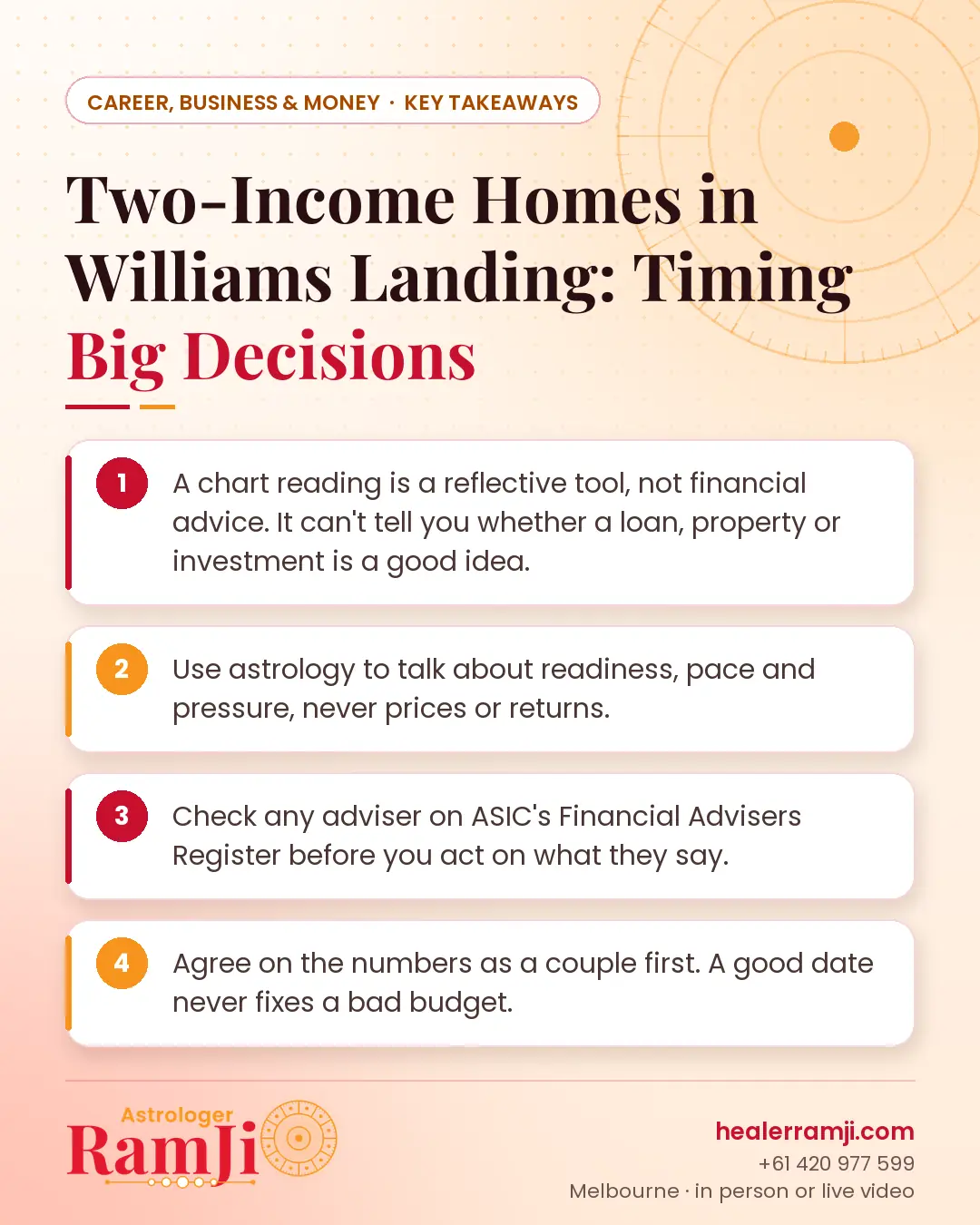
Key takeaways
- A chart reading is a reflective tool, not financial advice. It can't tell you whether a loan, property or investment is a good idea.
- Use astrology to talk about readiness, pace and pressure, never prices or returns.
- Check any adviser on ASIC's Financial Advisers Register before you act on what they say.
- Agree on the numbers as a couple first. A good date never fixes a bad budget.
Why do big decisions feel harder in a two-income home?
When both partners earn, both partners have a say. That's healthy, but it also means two sets of worries. One of you may want to act quickly. The other may want to wait another year. Add a long commute, a young child and parents back home who expect some help, and simple choices start to feel loaded.
In a newer suburb, many households bought or built at around the same time. It's easy to compare yourselves with the neighbours who renovated, upgraded the car or bought a second property. Comparison is a poor basis for any money decision. Your own figures, goals and comfort with risk are what count.

What can astrology offer for financial decision timing?
In Vedic astrology, timing is usually read through the dasha system, which divides life into planetary periods, and through slow transits such as Saturn and Jupiter. Many practitioners also use muhurta, the choice of a favourable moment to begin something. These are traditional methods, and astrologers read them in different ways. They are beliefs, not proven forecasts.
Used carefully, a reading can give a couple a structured way to talk. It might raise questions such as:
- Is this a stretch where you both feel tired, so a slower pace makes sense?
- Are you choosing out of fear of missing out, or because it fits your plan?
- Does one of you carry most of the money stress, and does the other know?
- If you do go ahead, is there a date that feels meaningful for signing or settling?
Our financial timing guidance works at this level. It is about reflection and readiness. It is not about which product to pick, what a property is worth or where the market will go.

What can't a chart tell you about money?
A chart can't tell you whether interest rates will rise, whether prices in your street will grow, or whether a share will pay off. An astrologer is not a licensed financial adviser, and a careful one won't act like one. If anyone offers you a lucky investment, a promised return or a ritual to make money flow, treat that as a warning sign. Our short answer on whether astrology should guide investment choices explains why.
Birth details matter too. If either of you doesn't know your birth time, the Moon's position can be uncertain, and dasha dates can shift by months or even years. In that case any timing reading is broad at best. It should never be the deciding factor.
Who should you speak to about the money itself?
For personal advice on investments, super or other complex products, see a licensed financial adviser. ASIC manages the Financial Advisers Register, which is published on Moneysmart. It lets you check that an adviser is authorised and registered before you get advice. ASIC also says the businesses that employ advisers, not ASIC itself, add and update those details, so ask your own questions as well as checking the listing.
Moneysmart is the government's free money guidance website, and it's a good place to read up before you meet anyone. For a home loan, talk to your lender or a mortgage broker. For tax, see a registered tax agent. If you're unsure who covers what, ask each person directly what they are licensed to advise on.
How can a couple use timing without letting it take over?
- Do the numbers first. Write down both incomes, fixed costs, savings, and what you'd do if one income stopped for six months.
- Get qualified advice. Take those numbers to a licensed adviser, broker or accountant, depending on the decision.
- Decide yes or no on the merits. If the plan doesn't stack up, no date will rescue it.
- Then, if you wish, choose a date. Some families like to sign, settle or start on a carefully chosen muhurat date. That's a cultural and spiritual choice, made after the practical one.
Keep any timing flexible. Settlements move, banks take longer than expected, and life gets in the way. A sensible reader will give you a window and a backup, not a single day you must hit.

What if you and your partner disagree?
Couples often disagree about money, and it doesn't mean the marriage is in trouble. Try to name what each of you is protecting. One partner may be guarding security. The other may be guarding opportunity. Both are reasonable.
A reading shouldn't be used to win the argument. If one partner wants an astrologer to overrule the other, slow down. Both people should agree to a joint session, and each chart should only be read with that person's consent. If money is being used to control you, such as being kept from your own pay or bank account, that is financial abuse. 1800RESPECT on 1800 737 732 can talk it through confidentially.
What about buying a home or moving house?
With property, the practical checks come first: a conveyancer or lawyer to review the contract, building and pest inspections, and loan approval in writing. Once that's settled, some families like to plan a house-warming or griha pravesh at a chosen time. That marks a new beginning. It doesn't make the purchase a better investment.

Getting support in the west
If you live in Williams Landing, sessions can be held by phone, WhatsApp or video, so you don't have to plan around peak-hour traffic on the freeway. Fees are stated before any paid work, and what you share stays confidential. You can read more about our work across Melbourne's western suburbs, or get in touch when you're ready.
Related service
Keep reading

Returning to Work From Officer After Parental Leave
Heading back to work after parental leave from Officer? Check your workplace rights, plan the commute and childcare, then see where career timing fits.
Read article →
Farming, Timing and Remedies: Staying Practical in Mildura
Thinking about astrology for your Mildura farm or orchard? What a chart can and can't do, scam warning signs, and where to get real farm financial help.
Read article →
What Your Tenth House Says About Work
How a tenth house career reading works in Vedic astrology: the sign, lord and planets involved, the D10 chart, and why no chart can name your job title.
Read article →More from Melbourne's Western Suburbs

Vastu for Older Beachside Homes in Altona
Living in an older Altona home near the bay? How to apply vastu to the layout you already have, what to check before any work, and what vastu cannot do.
Read article →
Renting in Maidstone: A Simple Home Blessing
Moved into a rental in Maidstone? A simple home blessing that respects Victorian renting rules, keeps smoke alarms working and leaves no marks behind.
Read article →
Finding a Priest Who Knows Your Family's Tradition
North and South Indian rites, calendars and customs differ. How to find a pandit in Melbourne's west who suits your family's tradition, and what to ask first.
Read article →Local pages
Astrologer for Footscray
Live in Footscray? Vijay Ramji is based in Ascot Vale, with sessions by phone, WhatsApp or video. Questions that fit apartments, study, shops and mixed families.
View area →
Astrologer for Sunshine
In Sunshine, Victoria? Vijay Ramji is based in Ascot Vale, with sessions by phone, WhatsApp or video. Questions about older homes, changing work and family.
View area →
Astrologer for Werribee
Live in Werribee? Vijay Ramji is based in Ascot Vale, with kundli readings by phone, WhatsApp or video. Questions for long-settled families and new arrivals.
View area →Quick answers
Should I use astrology to decide investments?
No. A chart can't tell you what to buy or sell. Here is who to ask instead, how to check an adviser, and what to watch for if a reader gives money tips.
Read answer →Can astrology help me choose a career?
Astrology can prompt useful questions about work, but it can't pick your career. Here is what a chart may suggest, its limits, and who to ask for real advice.
Read answer →Talk to Vijay Ramji
Tell us what you are facing. If a reading is unlikely to help, you will be told that plainly.