
The Three Phases of Sade Sati

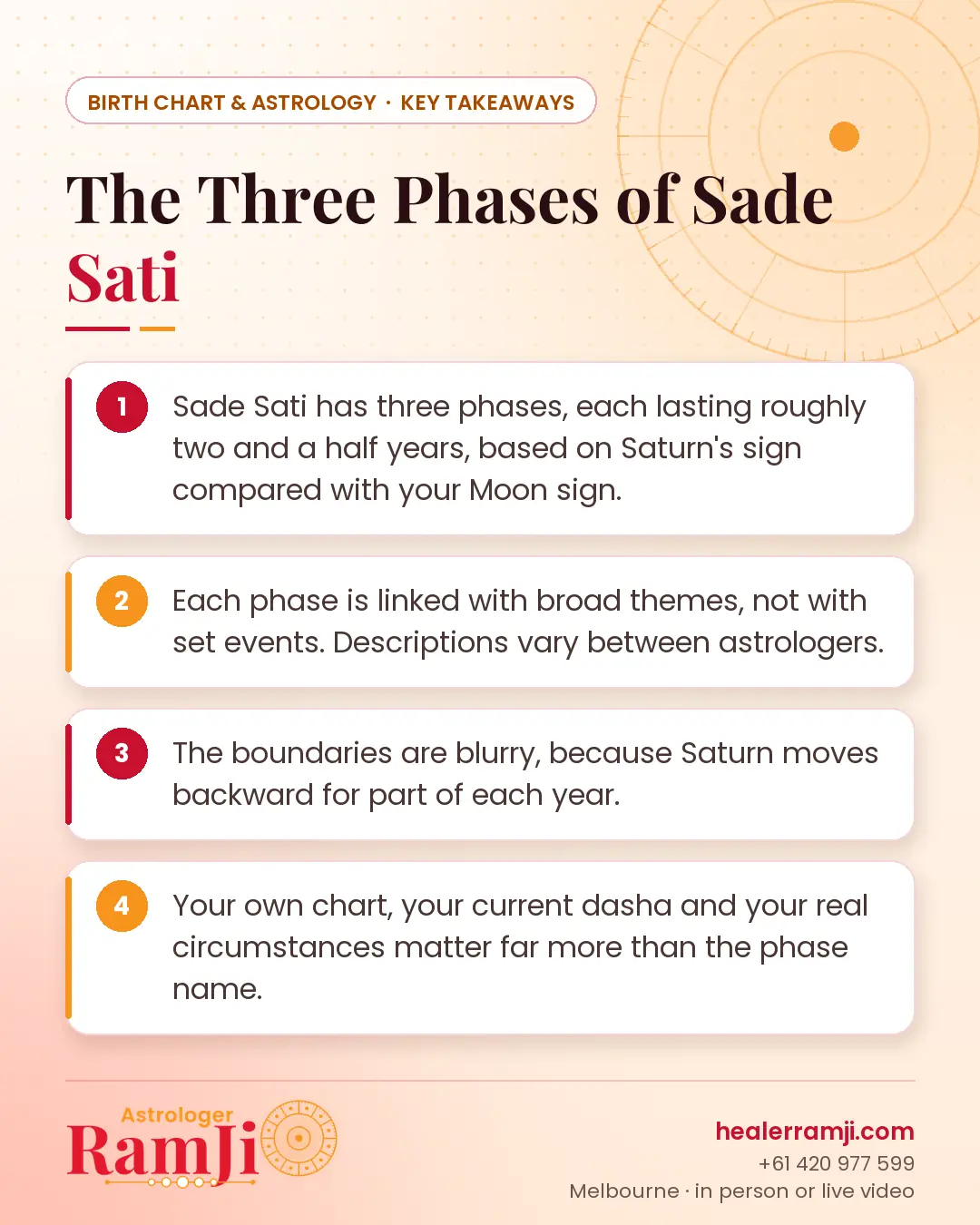
The three phases of Sade Sati follow Saturn through the sign before your Moon sign (rising), your Moon sign (peak) and the sign after it (setting), about two and a half years each. Tradition links them with letting go, responsibility and consolidation. These are themes for reflection, not predicted events.
Most people hear about Sade Sati as one long block of seven and a half years. In Vedic astrology it is usually split into three parts, and each part is described a little differently. Knowing which part you are in can turn a vague worry into something more specific and much easier to think about.
This article walks through each phase, what tradition tends to associate with it, and what it does not mean.
Key takeaways
- Sade Sati has three phases, each lasting roughly two and a half years, based on Saturn's sign compared with your Moon sign.
- Each phase is linked with broad themes, not with set events. Descriptions vary between astrologers.
- The boundaries are blurry, because Saturn moves backward for part of each year.
- Your own chart, your current dasha and your real circumstances matter far more than the phase name.
How are the three phases worked out?
Start with your Moon sign in the sidereal zodiac used by Vedic astrology. This is often different from the star sign in a Western horoscope. Then look at where Saturn is.
- Rising phase: Saturn is in the sign just before your Moon sign (the twelfth from the Moon).
- Peak phase: Saturn is in your Moon sign itself.
- Setting phase: Saturn is in the sign just after your Moon sign (the second from the Moon).
Saturn takes about 29.4 Earth years to orbit the Sun, so it spends roughly two and a half years in each sign. Three signs gives the seven and a half years that the name means. The Sade Sati entry also notes an alternative method that measures about 45 degrees either side of the Moon, rather than whole signs. That is one reason two astrologers can give you slightly different dates.
What is the rising phase traditionally linked with?
The twelfth house in Vedic astrology is linked with endings, expenses, sleep, distance and things happening behind the scenes. So the first phase is often described as a time of loosening. Old arrangements may stop working. Costs may feel higher. Some people find themselves thinking about moving, travelling or pulling back from groups that once suited them.
A practical way to use this theme is to ask what you are carrying that no longer fits. That might be a commitment you agreed to out of habit, or a spending pattern that crept up. Clearing some room early can make the later years feel lighter.
It does not mean you will lose money or have to leave home. Plenty of people move through this phase with little change at all.

What is the peak phase traditionally linked with?
When Saturn crosses your Moon sign, tradition says the pressure is felt most personally. The Moon stands for the mind and feelings in Jyotish, and Saturn is linked with duty, limits and patience. Together they are often described as a time of feeling more serious, more tested and more responsible.
Many astrologers also describe this as the phase of building character. Work done slowly and properly in these years is often said to last. The theme is less about bad luck and more about having fewer shortcuts.
Because the peak phase is the one people fear most, it is also the one where it helps to look at ordinary causes first. Tiredness, poor sleep and low mood are common signs of stress, and they deserve real attention whatever Saturn is doing. If you have felt low for a while, please talk to your GP.
What is the setting phase traditionally linked with?
The second house is linked with family, savings, food and speech. In the final phase, tradition often points to these areas. You may find yourself sorting out family finances, paying more attention to what you say and how you say it, or rebuilding savings after the earlier years.
Some astrologers describe this phase as a gradual easing, with results arriving for effort made earlier. Others say the second house can bring its own strain within the family. Both views exist, so treat any single description with some caution.
Useful questions for this phase include: Are our household money conversations clear? Do I speak to the people closest to me the way I want to? What do I want to have built by the time this period ends?
Why do the phases blur into each other?
Saturn appears to move backward in the sky for several months each year. This is called retrograde motion. Near a sign boundary, Saturn can cross into the next sign, move back, then cross again. So you may be in one phase, slip back into the previous one, then move forward once more.
This is why apps sometimes show a start date that is months away from what an astrologer tells you. Neither is necessarily wrong. They may be using different methods, or reading the boundary crossings differently. If the exact dates matter to you, ask your astrologer to explain which method they use.
Does every Moon sign feel the phases the same way?
No, according to tradition. Saturn rules Capricorn and Aquarius, and some astrologers read Sade Sati as gentler for those Moon signs. One view holds that an Aquarius Moon feels little ill effect, while charts linked with Leo feel more, because Leo's ruler, the Sun, is treated as Saturn's enemy. These are traditional opinions, and astrologers weigh them differently.
Your own chart adds more layers. Where Saturn sits in your birth chart, which dasha period you are running and how strong your Moon is all change how the phase is read. Two people in the peak phase at the same time can have very different years.
What can't the phases tell you?
Sade Sati is a traditional belief. There is no scientific evidence that Saturn's position affects your work, health or relationships. A phase name cannot tell you that a specific event will happen, and it should never be the reason you avoid medical care, leave a safe relationship or stay in an unsafe one.
It also cannot explain why a particular year was hard for you. With three of the twelve Moon signs in it at once, roughly a quarter of people are in some part of Sade Sati at any given time. If you have heard frightening stories, common Sade Sati myths sets them against what the tradition actually says.
How can you use the phases well?
The most helpful approach is to treat each phase as a prompt for reflection:
- Find your phase and its rough dates, and note that the edges are approximate.
- Pick one or two questions from the themes above that feel relevant to your life now.
- Make plans based on your real facts, with a doctor, accountant or other professional where needed.
- If you like traditional practice, keep it simple. Many people choose a short mantra, a Saturday lamp or giving to people in need. None of these needs to cost much.
If you would like your own dates set out and read against your chart, a Sade Sati consultation looks at the phase you are in and how it fits with everything else. A wider Saturn and Jupiter transit reading is another option if you want to see the bigger picture. Any fee is stated before paid work begins, and sessions can be held by phone, WhatsApp or video. To ask a question first, get in touch.
Related service

Keep reading

The 27 Nakshatras: A Beginner's Guide
A plain guide to the 27 nakshatras: why Jyotish puts the Moon's star ahead of your sun sign, how the stars are ordered, and what a birth star can't tell you.
Read article →
Choosing a Baby Name from the Birth Star
How families pick a baby name by nakshatra: finding the birth star and pada, using its syllable, and fitting it with Victorian registration rules.
Read article →
Using Your Varshphal as a Yearly Planner
Turn a varshphal reading into a working calendar: find your return date, map the year's periods to real dates, and review honestly as the months pass.
Read article →Quick answers
What is Sade Sati?
Sade Sati is a Saturn transit of about seven and a half years in Vedic astrology. Here is how it is worked out, why dates differ, and why it needn't cause fear.
Read answer →What is a kundli?
A kundli is a Vedic birth chart that maps the planets at your exact time and place of birth. Here is what it shows, in plain words.
Read answer →Talk to Vijay Ramji
Tell us what you are facing. If a reading is unlikely to help, you will be told that plainly.