
How to Use a Reading Without Giving Away Your Decisions
You shouldn't trust a psychic to make decisions for you. There is no scientific evidence that psychic ability exists, and a reader doesn't know your full situation. A reading can still be useful as a prompt: notice what it stirs in you, test it against the facts, and keep the final choice yours.
People rarely book a reading when life is calm. They book one when a choice is pressing: stay or leave, take the job or wait, move home or stay put. In that state, it is very tempting to hand the decision to someone who sounds certain.
This guide is about keeping hold of your own judgement. It shows how to use a reading as one input among many, so you come away clearer rather than more dependent.
Key takeaways
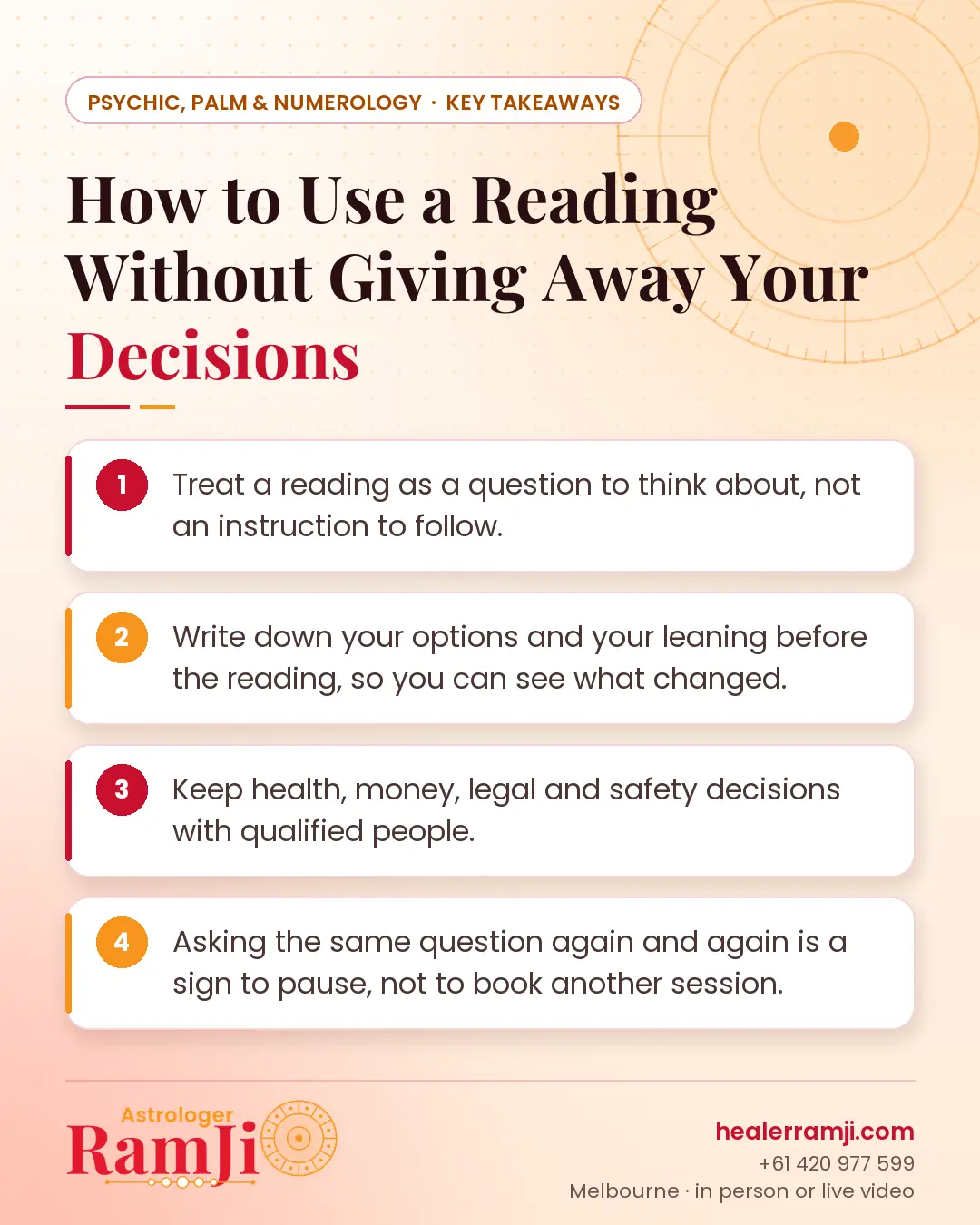
- Treat a reading as a question to think about, not an instruction to follow.
- Write down your options and your leaning before the reading, so you can see what changed.
- Keep health, money, legal and safety decisions with qualified people.
- Asking the same question again and again is a sign to pause, not to book another session.
Should you trust a psychic for decisions?
Not as the decider. The scientific consensus is that psychic abilities have not been shown to exist. Readings can still feel strikingly accurate, partly because broad statements fit many people and because we tend to remember the hits and forget the misses. A reader can do this without meaning to mislead anyone.
That doesn't make a reading worthless. Some people find that hearing their situation described from outside helps them notice what they already feel. The value lies in your reaction, not in the reader's authority.
What should you do before the reading?
Ten minutes of preparation makes a big difference. On one page, write:
- The decision, in one sentence.
- Your realistic options, including "wait".
- Which way you are leaning today, and why.
- What facts you still need, and who could give them to you.
- What you are most afraid of.
Keep the page. After the reading, you can compare and see whether anything really shifted, or whether you simply heard your own leaning said back to you. Our list of questions to bring to your first reading can help shape what you ask.
How do you listen without handing over the decision?
During the session, notice three kinds of statements:
- Observations, such as "you seem tired of carrying this alone". Ask yourself whether it is true.
- Predictions, such as "this will work out by spring". Hold these lightly. They can't be checked until it is too late to matter.
- Instructions, such as "you must leave him". Turn these into questions: "What would happen if I did? What would I lose?"
Pay attention to how you feel when a particular outcome is mentioned. A flash of relief or a sinking feeling often tells you more about your own preference than the words themselves. Some people get the same insight by tossing a coin and noticing what they hoped for while it was in the air.
What should you do after the reading?
Give it time before you act. Sleep on it at least once. Then go back to your page and ask:
- Did the reading raise anything I hadn't considered? Can I check it?
- Would I make this choice even if the reading had never happened?
- Who else should I talk to: my partner, a friend, a professional?
If the reading pointed one way and the facts point another, let the facts carry more weight.
Here is a generic example. Imagine someone weighing a job offer in Brisbane. The reader says "a move is coming". Rather than resigning that week, the person treats it as a prompt: they ask the employer about relocation support, check rents, and talk honestly with their partner about leaving family in Melbourne. The final call rests on those answers, not on the reading.
Which decisions should never rest on a reading?
Some choices need qualified advice, whatever a reader says:
- Health. Starting, stopping or delaying treatment belongs with your GP or specialist.
- Money. Investments, loans and large purchases belong with a licensed financial adviser.
- Legal and visa matters. Speak to a lawyer or a registered migration agent.
- Your safety. If you are afraid of someone, call 1800RESPECT on 1800 737 732, or 000 in an emergency.
- Other people's choices. No reading can tell you what someone else feels, intends or will do.
What if you keep going back for more readings?
It is common to want another reading when the first one didn't settle the worry. But asking the same question to several readers, or every few weeks, usually means the uncertainty itself has become the problem. More readings tend to bring more conflicting answers, not fewer.
Try setting a limit, such as one reading per decision, and a budget you won't go past. If a reader encourages frequent sessions about the same issue, or says something bad will happen unless you return or pay more, that is a warning sign. Our page on psychic reading red flags lists what to walk away from.
What if you are feeling very low?
When you are exhausted, grieving or frightened, it is harder to keep a reading in perspective. It may be kinder to wait until you are steadier, and to talk to someone who can support you in the meantime. A GP is a good place to start. healthdirect's crisis support page lists services that can help. You can call Lifeline on 13 11 14 or Beyond Blue on 1300 22 4636 at any time.
What does an ethical reader do?
A careful reader states the fee before starting, tells you plainly what a reading can't do, and leaves you free to disagree or stop. They encourage you to check things against your own life and to seek professional advice where it is needed. They don't create fear or urgency, and they treat what you share as confidential.
If you are curious about what a session involves, what to expect at a first psychic reading walks through it, and our short answer on whether psychic readings are real covers the evidence. A psychic reading with Vijay Ramji can be held by phone, WhatsApp or video, with fees stated first. If you would like one as a prompt for reflection, get in touch.
Related service

Keep reading

Samudrika Shastra: An Introduction
Samudrika Shastra meaning, history and branches explained, plus why this old tradition of reading the body should never be used to judge or screen other people.
Read article →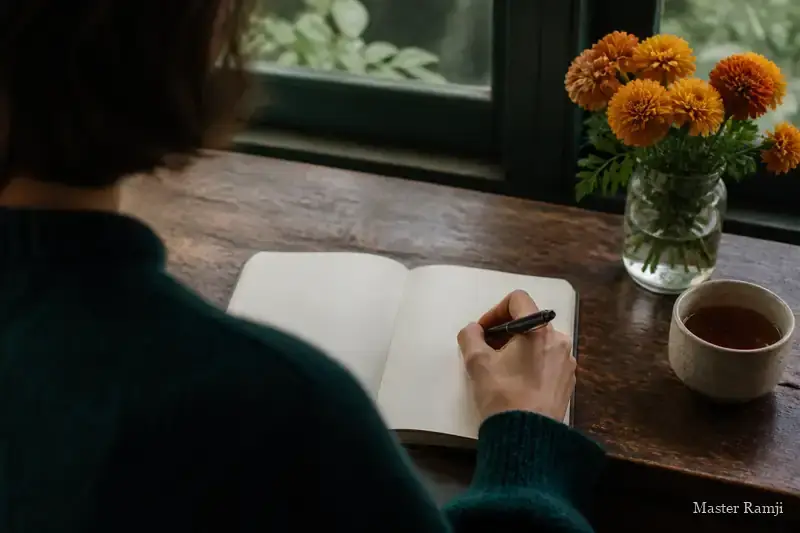
How to Work Out Your Birth and Destiny Numbers
How to calculate your destiny number and birth number, step by step, with a worked example, a check for master numbers, and the name-based method compared.
Read article →
Vedic and Pythagorean Numerology Compared
Why do Vedic and Pythagorean numerology give different numbers for the same name? A clear comparison of letter charts, birth numbers and what each system emphasises.
Read article →Quick answers
What is the difference between a psychic and an astrologer?
An astrologer works from a chart calculated from birth details, while a psychic relies on intuition. Here is how that changes what each reading can offer.
Read answer →Are psychic readings real?
Readings can feel real and meaningful, but no scientific proof shows that psychic powers exist. Here is what a reading can offer and when to walk away.
Read answer →Talk to Vijay Ramji
Tell us what you are facing. If a reading is unlikely to help, you will be told that plainly.