
What Wealth Houses Show and What They Don't

In Vedic astrology, the second house is linked with savings, family resources and speech, and the eleventh with income, gains and networks. Astrologers also look at their lords and combinations called dhana yogas. These are traditional themes for reflection. They can't predict your income, and they never replace a budget or licensed financial advice.
Ask a group of people what they want to know from a birth chart, and money comes up quickly. Will things get easier? Is this a good period for income? Why does money always seem to leak away? Vedic astrology does have a vocabulary for these questions, built mostly around the second and eleventh houses.
This article explains what those houses are read for, how money periods are discussed, and why the most useful thing a chart can do for your finances is send you back to your own numbers.
Key takeaways
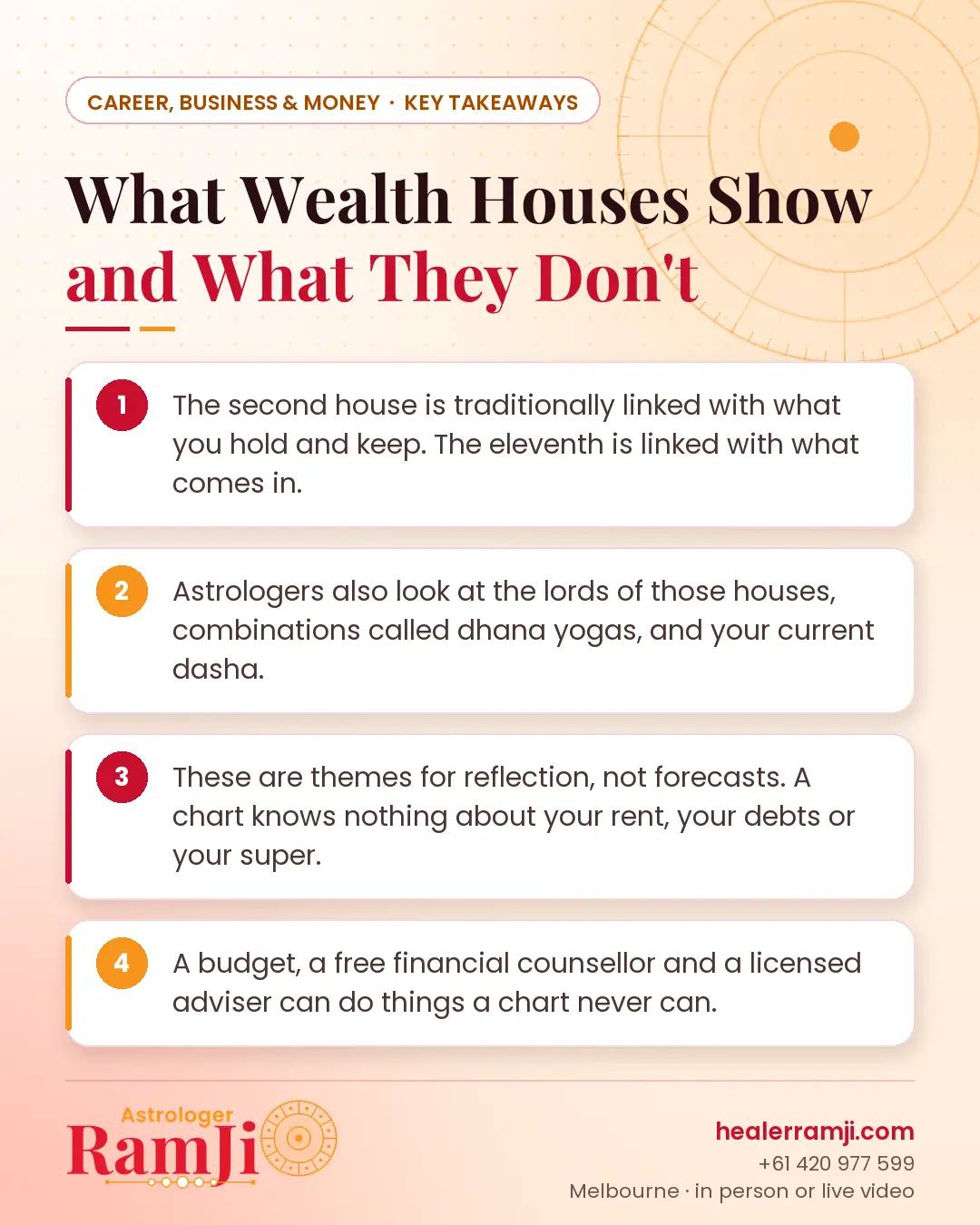
- The second house is traditionally linked with what you hold and keep. The eleventh is linked with what comes in.
- Astrologers also look at the lords of those houses, combinations called dhana yogas, and your current dasha.
- These are themes for reflection, not forecasts. A chart knows nothing about your rent, your debts or your super.
- A budget, a free financial counsellor and a licensed adviser can do things a chart never can.
What does the second house show?
In Jyotish, the second house is often called the house of wealth, or dhana. Tradition links it with:
- savings and accumulated resources
- family, especially the household you grew up in and what it passed on
- speech, food and the values you were raised with
That mix is telling. The tradition ties money to family and to the habits you absorb at home. A reading of this house often turns into a conversation about how money was talked about when you were young, whether it was saved, sent away or never mentioned. That conversation can be more useful than any prediction.
What does the eleventh house show?
The eleventh house is traditionally called labha, the house of gains. It is linked with income, fulfilled wishes, older siblings, friends and networks. Many astrologers read it as how opportunities reach you, often through other people.
Again, the reflective use is the practical one. If a reading points to networks, the useful question is whether you are asking for the pay rise, applying for the role or telling people what you do. The chart can't do any of that for you. If you'd like a wider view of all twelve houses, see our plain guide to the twelve houses.

What is a dhana yoga?
A yoga in astrology is a combination of planets. Dhana yogas, or wealth combinations, are described as involving wealth-giving planets such as the lord of the second house and the lord of the eleventh. Many astrologers also bring in the lords of the fifth and ninth houses, which tradition links with fortune and merit. Classical texts list many such combinations, and astrologers weigh them differently.
Two cautions matter here. First, almost every chart contains something that can be called a dhana yoga if you look hard enough, which is why readers who spot one in every client should be treated with care. Second, even the traditional view says a yoga describes potential that depends on effort, timing and circumstance. It is not a promise of money.
What about the sixth, eighth and twelfth houses?
A fuller money conversation usually brings in the houses linked with outflow. The sixth is linked with debts and daily work, the eighth with shared or unexpected resources such as inheritance, insurance and a partner's money, and the twelfth with spending, loss and expenses abroad. For migrants sending money home, the twelfth often prompts a frank talk about how much is going out, and whether the family has agreed on it.

Can a chart show good and bad money periods?
Astrologers often discuss money through your current dasha, the planetary period in the Vimshottari timeline, along with slow transits like Saturn and Jupiter. A period might be read as one of responsibility and tightening, or of growth and movement. A dasha analysis looks at that timeline in more detail.
Here's the honest limit. There is no reliable evidence that these periods predict income, prices or markets. And dasha dates depend on an accurate birth time. Without one, they can shift by months or years. Treat any "money period" as a prompt to review your situation, not a reason to spend, borrow or invest.
Why can't a chart replace a budget?
Because a budget deals in facts. It knows how much comes in each fortnight, what the mortgage or rent costs, how much goes overseas and what's left. A chart knows none of this. Two people with similar charts can have very different incomes, debts and responsibilities.
A budget also changes your situation in a way a reading can't. You can see where money goes, decide what to cut and set goals you can measure. Moneysmart, run by the regulator ASIC, has free tools such as a budget planner, along with guidance on saving, debt and choosing a financial adviser.
If a reading leaves you feeling either lucky or doomed about money, check your budget before you act on that feeling. The numbers are the better guide.
What if money is already tight?
Then a chart is the wrong place to start. If you're behind on bills, worried about a loan or getting calls from creditors, contact the National Debt Helpline. It says its financial counselling is always free and confidential, and that its counsellors don't lend money or sell you anything. Our article on getting real help with debt stress has more on where to start.
Please don't pay for a remedy, gemstone or puja on credit in the hope it will fix money problems. No such purchase can be shown to improve your finances, and it adds to the pressure.
Should astrology ever guide an investment?
No. A chart can't pick shares, property or crypto, and it can't time a market. Our short answer on whether to use astrology for investment decisions explains who to ask instead. Nothing in a reading counts as financial advice, and a reader who names an investment or a "lucky" date to trade is stepping well outside what astrology can do.
So where can a wealth reading help?
Used well, it can help you think about your relationship with money. You might notice a family pattern you've repeated, or a habit of avoiding the subject. A reading can be a nudge to finally book the appointment with a financial counsellor or adviser, or to have the money talk with your partner. Those are modest outcomes, and they depend on what you do next.
Financial timing guidance is built around that kind of reflection. It picks no investments and doesn't tell you to borrow. Fees are stated before any paid work, and sessions can be held by phone, WhatsApp or video. If that sounds useful, please get in touch.
Related service

Keep reading

Why Astrology Should Never Pick Your Investments
No chart can choose a share, coin or property. Why astrology investing advice is risky, how to check a licensed adviser, and the warning signs of a scam.
Read article →
Debt Stress: Getting Real Help First
Debt stress help in Australia starts with free financial counselling, not a remedy. What the National Debt Helpline does, your hardship rights and what to avoid.
Read article →
Lakshmi Puja for Business Owners
Lakshmi puja for business owners: what the Diwali rite involves, how to adapt it to a shop or office in Australia, account book customs, and fire safety at work.
Read article →Quick answers
Should I use astrology to decide investments?
No. A chart can't tell you what to buy or sell. Here is who to ask instead, how to check an adviser, and what to watch for if a reader gives money tips.
Read answer →Can astrology help me choose a career?
Astrology can prompt useful questions about work, but it can't pick your career. Here is what a chart may suggest, its limits, and who to ask for real advice.
Read answer →Talk to Vijay Ramji
Tell us what you are facing. If a reading is unlikely to help, you will be told that plainly.