
Fasting as a Remedy: Doing It Safely

Hindu fasting for planets can be done safely only if your health allows it. If you have diabetes, are pregnant or breastfeeding, take regular medication, are underweight or have had an eating disorder, talk to your doctor first or choose another remedy. Others can keep a gentle fast, drink water and stop if they feel unwell.
A reader suggests fasting on Saturdays for Saturn, or Mondays for the Moon. Your grandmother kept a weekly vrat for decades and seemed none the worse for it. So it sounds simple. But fasting is the one traditional remedy that can directly affect your health, and what suited one person may not suit you.
This article puts health first. It covers who should check with a doctor before fasting, how the common planetary fasts work, and how to adapt or replace a fast so you keep the meaning without the risk.
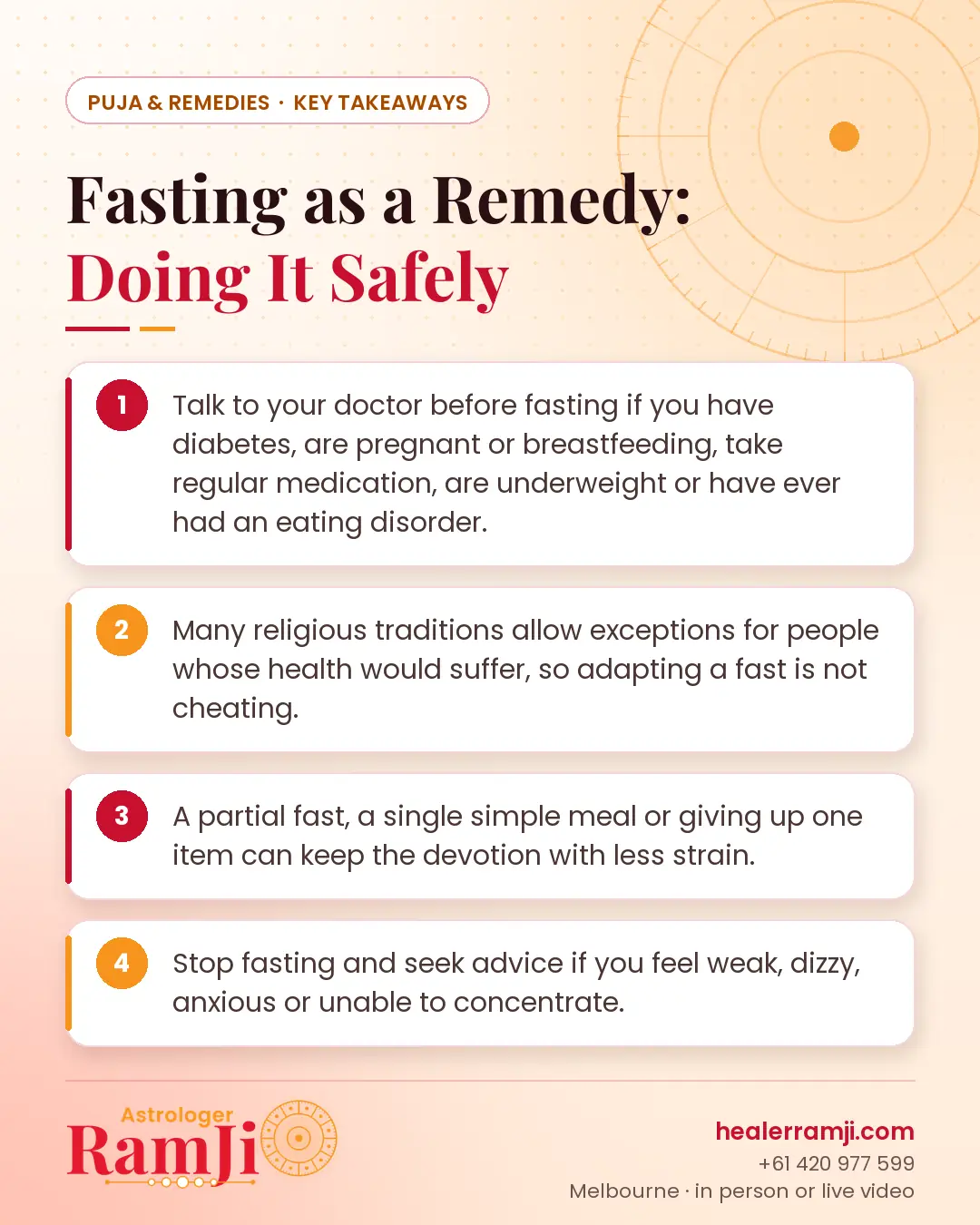
Key takeaways
- Talk to your doctor before fasting if you have diabetes, are pregnant or breastfeeding, take regular medication, are underweight or have ever had an eating disorder.
- Many religious traditions allow exceptions for people whose health would suffer, so adapting a fast is not cheating.
- A partial fast, a single simple meal or giving up one item can keep the devotion with less strain.
- Stop fasting and seek advice if you feel weak, dizzy, anxious or unable to concentrate.
Who should not fast without medical advice?
This is the most important section, so please read it before anything else. healthdirect's guidance on fasting says you should not do intermittent fasting if you:
- are underweight
- have, or have previously had, an eating disorder
- are pregnant or breastfeeding
- are a child or teenager
- are an older adult
- take daily medicine that must be taken with food
It adds that people having cancer treatment or taking diabetes medicines should talk to their doctor to see if fasting is safe. That guidance is written about intermittent fasting for health, but the same bodies are doing the fasting during a vrat. If any of these apply to you, speak to your GP before you keep a religious fast, and consider one of the alternatives further down.
What if you have diabetes?
The National Diabetes Services Scheme lists religious observance as one reason people with diabetes fast, and says it is very important to talk with your doctor about how to manage it. Your doctor or diabetes educator may adjust your medication so you can fast more safely. The NDSS also warns that blood glucose can run high if medication is skipped, and that long gaps followed by large meals can cause big swings in blood glucose levels.
So don't skip or change diabetes medication to fast without advice, and tell your doctor about any trouble you had in past fasts. The NDSS Helpline is 1800 637 700. In an emergency, call 000.
What if you are pregnant or breastfeeding?
Pregnancy, Birth and Baby notes that many religions that include fasting allow exceptions or adjustments for people who are pregnant or breastfeeding. It says fasting in pregnancy may cause dehydration and fatigue, and that many doctors advise against fasting in the second or third trimester. If you have a complication such as gestational diabetes, ask your doctor or midwife before fasting. If you feel light-headed or dizzy while fasting, contact a healthcare professional.
Talk to your doctor or midwife well before a fast you'd like to keep, and to your family priest or elder about what your tradition allows. Many families are relieved to hear the exception exists.
What if you take regular medication?
Don't stop, skip or move a dose to fit a fast without speaking to your doctor or pharmacist first. Some medicines need to be taken with food. Others work best at steady times. A pharmacist can often tell you quickly whether a planned fast will clash with your medicine.

What if you have a history of disordered eating?
Fasting for religious reasons can still trigger old patterns, even when the intention is devotion. healthdirect lists a current or past eating disorder among the reasons not to fast. If this applies to you, choose a remedy that doesn't involve food, such as prayer or service, and let your treating team know if a family or religious fast is causing pressure. The Butterfly Foundation supports people affected by eating disorders. Keeping your recovery safe is fully in keeping with the spirit of a remedy.
Which fasts are linked with the planets?
For those whose health allows it, popular tradition links each weekday with a graha, and many families fast on that day. The usual pairings are Sunday with the Sun, Monday with the Moon, Tuesday with Mars, Wednesday with Mercury, Thursday with Jupiter, Friday with Venus and Saturday with Saturn. Families often connect these with deities too, such as Monday with Shiva or Tuesday and Saturday with Hanuman. Customs vary by region and family, so ask your elders what yours keeps.
Fasts also differ in strictness:
- Phalahar: fruit, milk and certain permitted foods through the day.
- One meal: a single simple meal, often after sunset or after prayer.
- Giving up one item: such as grains or salt for the day.
- Nirjala: no food or water. This carries the highest risk of dehydration, and it isn't a good idea for most people, particularly on a hot day or a working shift.
How can you fast more gently?
If you've checked your health and want to go ahead, a few habits help:
- Start with the mildest form. A single simple meal or phalahar before anything stricter.
- Drink water. healthdirect notes that you may need to drink more water to avoid dehydration when fasting.
- Plan the day. Avoid fasting on a day with heavy physical work, a long shift or a long drive. If you feel light-headed, don't drive.
- Break the fast gently. A modest meal, not a feast.
- Know when to stop. healthdirect advises stopping and seeing a doctor if you feel weak, anxious or irritable, can't concentrate or can't do your usual activities.
What can you do instead of fasting?
Plenty, and many teachers consider these just as fitting. You could chant the planet's mantra on its day, give time or food to someone in need, or give up a habit like social media or snacks between meals rather than all food. Our list of astrology remedies that cost nothing has more ideas. If you're managing a health condition alongside your faith, our article on keeping your faith and seeing a doctor may help.
What should you be wary of?
Be cautious if anyone insists you must fast despite a health condition, recommends long fasts, tells you to stop medication, or warns that harm will come if you break a fast to look after yourself. None of that reflects caring practice. A fast is a personal offering, and it should never put your health at risk.
What can a fast honestly offer?
For people who value it, a fast can bring focus, a sense of devotion and a weekly pause. It can't be shown to change a planet's influence, and there's no evidence it improves a difficult period. If you're going through a hard stretch, our guide to getting through a difficult dasha has practical ideas alongside spiritual ones.
A personal mantra remedy plan treats fasting as optional and leaves it out altogether when it isn't safe for you. Sessions can be held by phone, WhatsApp or video, and fees are stated before paid work. To talk about a plan that fits your health and routine, please get in touch.
Related service
Keep reading
Charity as an Astrological Remedy
Which gifts tradition links with each planet, how to turn them into useful local giving, and how to check a charity is registered before you donate.
Read article →
What to Do If a Remedy Does Not Seem to Work
If an astrology remedy isn't working, it is not your fault, and paying more won't fix it. Honest expectations, signs to stop paying and how to get real help.
Read article →
Diwali Puja Timing in Melbourne
Why Diwali puja time in Melbourne differs from India: local sunset, daylight saving and the rising sign. How to check the right window and keep lamps safe.
Read article →Quick answers
Do astrology remedies have to cost money?
Astrology remedies don't have to cost money. Many traditional ones are free, such as mantra and service. Here is when a fee is fair and when to walk away.
Read answer →Why are mantras chanted 108 times?
Mantras are chanted 108 times because 108 is a sacred number in Hindu tradition and the count of beads on a mala. Here are the usual explanations.
Read answer →Talk to Vijay Ramji
Tell us what you are facing. If a reading is unlikely to help, you will be told that plainly.