
Rebuilding Trust After It Is Broken

To rebuild trust in a relationship, the person who broke it must take full responsibility, stop the behaviour and be open over time. The hurt partner needs room to ask questions and to decide freely. Both need patience, and many couples benefit from counselling. Trust can't be rebuilt where there is fear or control.
Trust rarely breaks in a single moment for both people. One partner usually knew for a while. The other finds out all at once. That gap is part of why repair feels so uneven, and why the two people have different work to do.
This article looks at what rebuilding trust asks of each person, what helps, and when trying again may not be the right goal.
Key takeaways
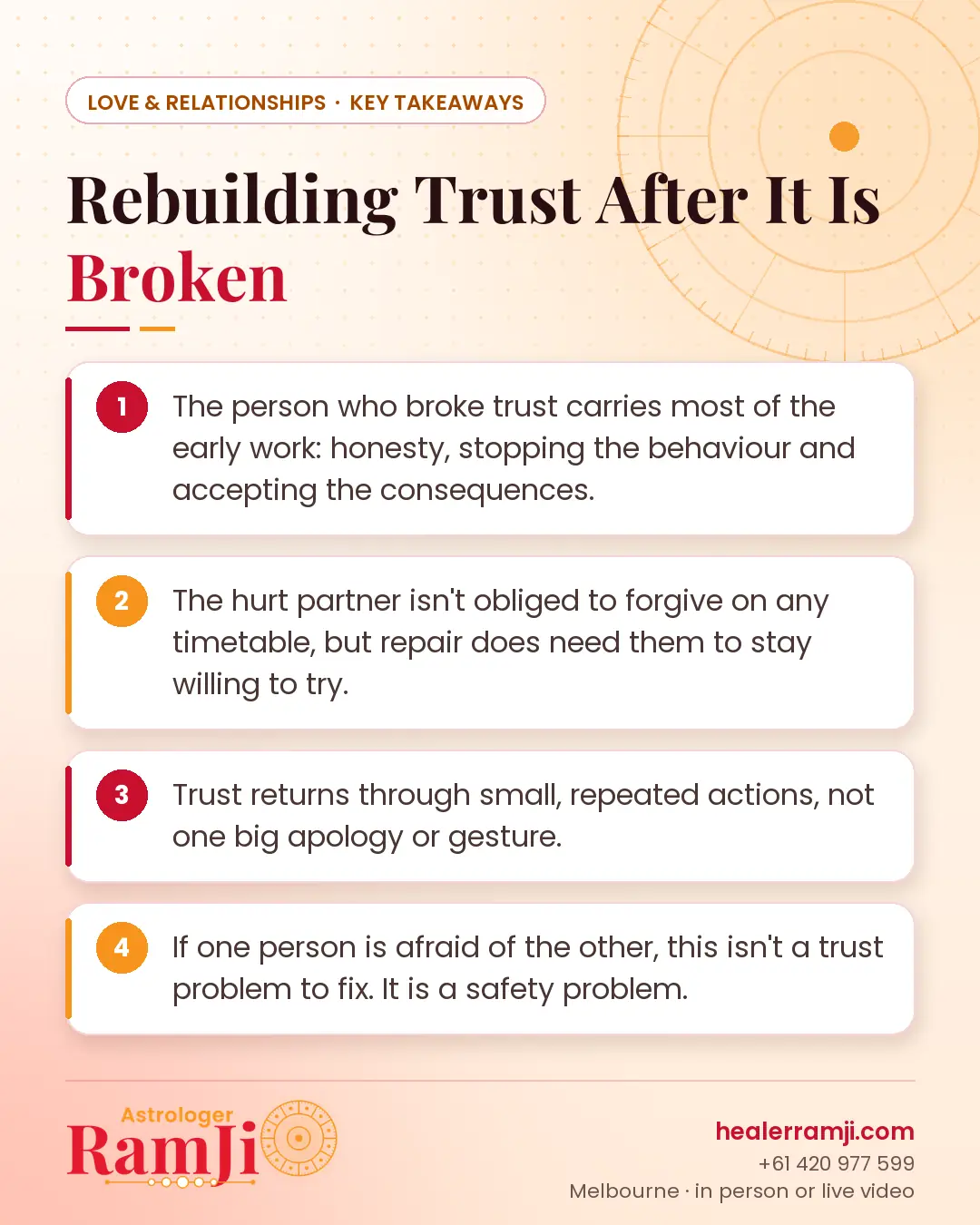
- The person who broke trust carries most of the early work: honesty, stopping the behaviour and accepting the consequences.
- The hurt partner isn't obliged to forgive on any timetable, but repair does need them to stay willing to try.
- Trust returns through small, repeated actions, not one big apology or gesture.
- If one person is afraid of the other, this isn't a trust problem to fix. It is a safety problem.
Is it safe to try?
Start here, because everything else depends on it. Rebuilding trust assumes two people who can disagree without fear. 1800RESPECT explains coercive control as a persistent pattern of behaviour used to dominate, control and isolate someone. It often leaves no visible physical injuries. If your partner checks your phone, controls your money, cuts you off from people or frightens you, the advice below doesn't apply. Please contact 1800RESPECT on 1800 737 732, or call 000 in an emergency. Our article on red flags of a controlling relationship has more.
What does the person who broke trust need to do?
If you are the one who lied, hid money or had an affair, your partner will watch what you do far more than what you say. The early work is yours:
- Stop the behaviour completely. Ending an affair "mostly", or still hiding a credit card, keeps the wound open.
- Tell the truth in one go. Drip-fed disclosures are among the hardest things for a partner to recover from. Each new detail feels like a fresh betrayal.
- Take responsibility without excuses. You can explain context later. At first, "I did this and it was wrong" matters more than why.
- Answer questions patiently. Your partner may ask the same thing many times. That is often how people process a shock.
- Be open before you are asked. Mention the late meeting or the unexpected bank charge yourself. Volunteering information shows you have nothing to hide.
Accepting consequences is part of this. Your partner may need space, may tell a trusted friend, or may decide not to stay. Pressuring them to "move on" usually slows repair down.

What does the hurt partner need?
If you were betrayed, you don't owe anyone a quick recovery. Still, it helps to know what repair tends to ask of you:
- Time to decide. You don't have to choose straight away whether to stay. Big decisions made in the first days of shock are often revisited.
- Room for your questions. Ask what you need to know. You may find some details help and others only hurt, so it is fine to stop asking.
- Support of your own. A friend, a counsellor or a GP can hold some of what your partner can't.
- A point where you notice change. If repair is working, there will come a time to let some good days count, without forgetting what happened.
Many people are tempted to track a partner's phone or location after a betrayal. It is an understandable urge, but checking rarely brings peace, and it can turn into the very control that harms relationships. Agreed openness, offered freely, works better than surveillance.
What do both people need to do together?
After the first weeks, repair becomes shared work. The Better Health Channel's advice on relationship conflict notes that conflict usually builds from underlying feelings and unresolved issues, and suggests that each person own their part. In the context of betrayal, that doesn't mean the hurt partner caused it. It means both look honestly at what was going on in the relationship before, so the same gaps don't open again.
Some couples find these steps useful:
- Agree on what openness looks like, such as sharing whereabouts or money decisions, and for how long.
- Set a regular time to talk about how things are going, so the subject doesn't hijack every evening.
- Keep some ordinary life going, like meals, walks and time with family, so the relationship is not only about the hurt.
Our guide on how couples can disagree without damage covers the conversation skills that make these talks less likely to blow up.

How long does rebuilding trust take?
There is no fixed timeline, and anyone who gives you one is guessing. Small things may feel easier within a few months, while anniversaries and reminders can stir things up much later. A useful sign is direction, not speed. Are the hard days getting further apart? Is the person who broke trust still showing up consistently when it is no longer new?
When does counselling help?
Often. A counsellor can slow conversations down and help each person hear the other. Relationships Australia Victoria offers couples counselling by phone, video and at its centres, with fees based on income. It also notes that you can attend relationship counselling on your own, which matters if your partner won't come or you aren't ready to sit in a room together.
Counselling is a good idea if you keep having the same fight, if one of you can't stop asking for details months later, or if you can't agree whether to stay.
When is it time to stop trying?
Repair needs both people. If the betrayal keeps happening, if the person who broke trust blames you for it, or if you find you no longer want the relationship, it is reasonable to end it. Leaving is not a failure. Our article on when getting back together is the wrong goal looks at these signs in more detail.
Where does astrology fit, if at all?
For couples who value it, a chart can offer a calm way to talk about temperament, such as how each person reacts under stress or what each needs to settle. It cannot tell you whether a partner was unfaithful, whether they will be again, or whether to forgive. Be very wary of any reader who claims to see an affair or names a third person.
Trust and conflict guidance is meant for couples who both feel safe and want another lens alongside the practical work above. What you share is confidential, and sessions can be held by phone, WhatsApp or video. If that would be useful, please get in touch.
Related service

Keep reading
Control Is Not Love: Red Flags to Take Seriously
Coercive control can look like care at first. Learn the signs of a controlling relationship, how faith can be misused, and where to get real help in Victoria.
Read article →
Why Vijay Ramji Does Not Offer Vashikaran
Vashikaran aims to control another person's will, so it is refused on principle. Why consent matters, why good intentions don't change it, and what helps instead.
Read article →
How to Tell Your Parents About Your Relationship
Planning to tell your Indian or South Asian parents about a partner? Map your family, prepare for their questions, choose the moment and know when safety comes first.
Read article →Quick answers
Can astrology bring my ex back?
No, astrology can't make your ex come back, and nobody can honestly promise it. Here is what a reading can help with, and how to avoid costly promises.
Read answer →Is vashikaran ethical?
No. Vashikaran aims to control another person, which is unethical and is refused here. Why consent matters, and where to turn if you feel pressured or controlled.
Read answer →Talk to Vijay Ramji
Tell us what you are facing. If a reading is unlikely to help, you will be told that plainly.