
Long-Distance Within Victoria: Warrnambool and Melbourne

A long distance relationship between Warrnambool and Melbourne often strains over travel, not feelings. The train or drive takes hours each way, so one partner can end up doing most of it. Agree on a fair travel pattern, count money and energy as well as kilometres, and review the plan every few months together.
When people picture a long-distance couple, they often imagine different countries and time zones. But plenty of couples live in the same state and still only see each other on weekends. One partner works in Melbourne. The other has a job, a family farm, study or ageing parents in Warrnambool. The distance is shorter, but the weekly travel can wear a relationship down in its own way.
This page looks at that weekend pattern, and at the quieter problem underneath it: one person putting in more effort than the other.
Key takeaways
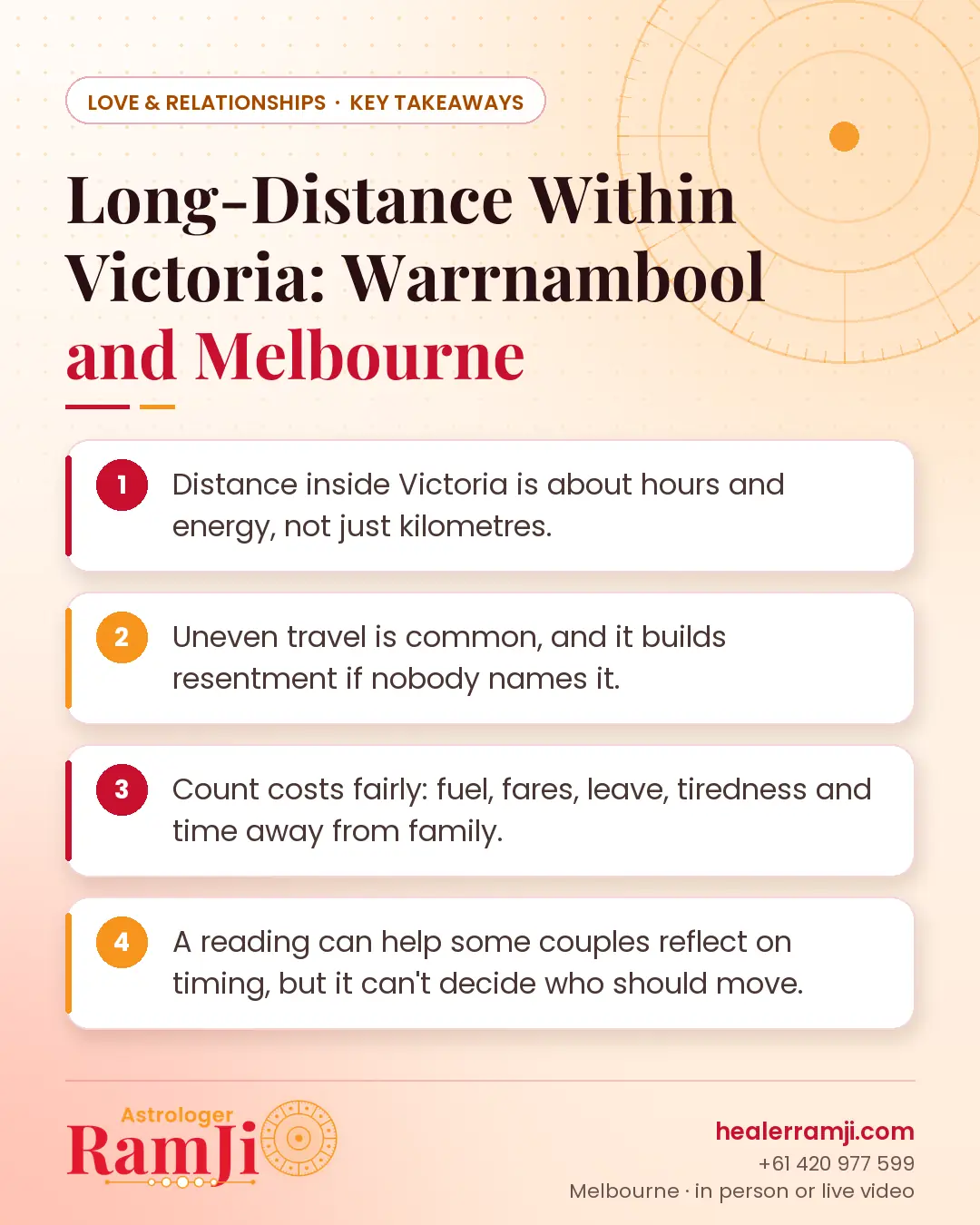
- Distance inside Victoria is about hours and energy, not just kilometres.
- Uneven travel is common, and it builds resentment if nobody names it.
- Count costs fairly: fuel, fares, leave, tiredness and time away from family.
- A reading can help some couples reflect on timing, but it can't decide who should move.
What makes Warrnambool to Melbourne different?
Warrnambool is a coastal city on the Princes Highway in the state's south-west. Victorian Places describes it as sitting between the Merri and Hopkins Rivers, with a railway extension from Terang that reached the city in 1890. It is a regional city with a Deakin University campus, its own industries and a full working life, which is exactly why one partner often can't simply leave.
The trip to Melbourne isn't a quick hop. A scheduled V/Line train from Warrnambool to Southern Cross, stopping at towns such as Terang, Camperdown, Colac and Geelong, takes around three and a half hours, depending on the service, so check V/Line's current timetable. Driving also takes several hours once you add a rest stop and city traffic. The coast road through the Great Ocean Road region is beautiful on a holiday, but it is much slower for a regular weekend run.
Trackwork also happens. V/Line's service changes page lists planned disruptions, and on some weekends coaches replace trains for part of a trip. If your plans hinge on a Friday night train, check before you leave.
Why does uneven effort cause so much trouble?
In many couples split between a regional city and Melbourne, one person ends up travelling more. Sometimes it starts by accident. The Melbourne partner has a car and a flexible roster, so they drive down. Months later, they're doing every trip, and the other person hasn't noticed.
The partner who travels may start to feel taken for granted. The partner who stays may feel guilty, or may feel they're giving up just as much by keeping weekends free and hosting. Both can be true. The trouble begins when each person keeps score privately and the other has no idea a score exists.
Signs the balance has slipped include:
- one person cancelling plans with their own friends every weekend
- arguments that start on Sunday afternoon, just before the drive home
- comments about money spent on fuel or fares that come out as jokes but aren't really jokes
- a sense that visits are about recovering from the trip rather than enjoying each other

How do you share the travel fairly?
Fair doesn't always mean equal. One partner may work weekends, or may care for a parent who can't be left. What matters is that you both agree on the arrangement and it feels reasonable to both of you. Some options couples use:
- Alternate weekends. Simple and easy to track, if both people can travel.
- Swap the cost, not the trip. If one person always travels, the other covers more of the fuel, fares or meals.
- Meet partway. A town in between, such as Geelong or Colac, can turn a long trip into two shorter ones now and then.
- Longer, less frequent visits. Some couples find that every second weekend with an extra day of leave is less tiring than every weekend rushed.
- Plan the quiet weeks. Decide when you'll call, and what a "normal" weeknight check-in looks like, so the gaps don't feel empty.
Write the plan down, even loosely. Then set a date, perhaps every three months, to ask whether it still works. Jobs, rosters and seasons change.
How do you raise it without starting a fight?
Pick a calm time, not the end of a long drive. Start with what you want, not what the other person is failing to do. "I'd love to have one weekend a month where I don't have to travel" is easier to hear than "You never come to me."
Listen for the reasons behind the pattern. The partner in Warrnambool may be anxious about city driving, short of leave, or carrying family duties you don't see. The partner in Melbourne may be paying high rent and stretched thin. If talks keep going in circles, Relationships Australia Victoria offers counselling for couples, families and individuals. Ask about session options that suit two people who live in different towns.

Where does the bigger question fit, about who moves?
Eventually, many couples in a long distance relationship in regional Victoria face a harder conversation: will one of you relocate, and when? That decision involves work, housing, family and, for some, visas or study. A chart can't make it for you, and nobody should tell you a particular planet means you must move.
Some people still find it useful to look at timing in a reflective way. In Jyotish, a long-distance relationship guidance session might look at which periods in your own chart are traditionally linked with change, travel or home. These are traditional interpretations, not predictions you can rely on, and they work best as prompts for a practical conversation. A joint reading should only include your partner's chart if they've agreed to it.
If you want to know what a reading can and can't do here, the short answer on whether a reading can help a long-distance relationship is a good place to start. Couples split between countries face different pressures, which are covered in making Melbourne to India long distance work.
What helps between visits?
- Share small, ordinary things: a photo of the Hopkins River on your walk, a picture of what you cooked.
- Keep one shared routine, such as a call on the same night each week.
- Have something on the calendar. A visit you know is coming makes a hard week easier.
- Protect your own life in each town. Friends, sport and community keep each of you steady.
Can a session help from Warrnambool?
Sessions can be held by phone, WhatsApp or video, so neither of you needs to add another trip to Melbourne. Vijay Ramji is based in Ascot Vale, appointments are arranged in advance, fees are stated before paid work, and what you share is confidential. You can read our guides for regional Victoria or get in touch to ask a question first.
Related service

Keep reading

Pressure to Marry: Setting Boundaries in Noble Park
Feeling family pressure to marry in Noble Park? Respectful ways to say not yet, where pressure ends and force begins, and free support if you need it.
Read article →
International Students in Footscray: Relationship Pressure
Studying in Footscray and feeling the strain in a relationship? Why isolation adds pressure, how to steady yourself, and verified places to get free support.
Read article →
The First Month After a Breakup
A week-by-week guide to the first month after a breakup: looking after yourself, handling contact with your ex, and when to seek more support.
Read article →More from Regional Victoria

Planning a Melbourne Wedding From Wangaratta
Parents in Wangaratta helping plan a Hindu wedding in Melbourne? How to coordinate the priest, the muhurat and the paperwork when you live hours away.
Read article →
Remote Home Cleansing for Western Victoria
Live in Horsham or western Victoria? What a remote home cleansing can and can't do, what you do yourself, and how to keep lamps and flames safe at home.
Read article →
Meditation and Mantra on the Surf Coast
Want a steady meditation or mantra practice in Torquay without joining a studio? Simple ways to fit it around surf, seasons and work on the Surf Coast.
Read article →Local pages
Astrologer for Geelong
For Geelong residents asking about vastu in Armstrong Creek, life after Deakin or worship in a smaller community. Sessions by phone, WhatsApp or video.
View area →
Astrologer for Ballarat
For Hindu families settling in Ballarat: older homes, cold winters and keeping traditions going. Vedic astrology by phone, WhatsApp or video, from Ascot Vale.
View area →
Astrologer for Bendigo
For people in Bendigo far from Melbourne's big temples: finding a match, goldfields homes and home worship. Vedic astrology by phone, WhatsApp or video.
View area →Quick answers
Can a reading help a long-distance relationship?
A reading can help a long-distance relationship as a way to reflect on timing and communication. It can't predict a visa or tell you what your partner is doing.
Read answer →Can astrology bring my ex back?
No, astrology can't make your ex come back, and nobody can honestly promise it. Here is what a reading can help with, and how to avoid costly promises.
Read answer →Talk to Vijay Ramji
Tell us what you are facing. If a reading is unlikely to help, you will be told that plainly.