
Affordable Substitute Gemstones
Substitute gemstones in astrology, called uparatna, are lower-cost stones linked to the same planet as a main gem, such as garnet for ruby or moonstone for pearl. Lists differ between traditions, and some astrologers don't accept substitutes at all. No gemstone, main or substitute, has a proven effect on health or fortune.
Someone looks at your chart and suggests a yellow sapphire or a ruby. Then you see the price. For many people, a fine natural stone would cost weeks or months of income. That's where substitute stones come in, known in the tradition as uparatna, or secondary gems.
This guide explains what uparatna are, which stones usually appear on the lists, and how to buy sensibly if you choose one. It also covers what any stone can't do.
Key takeaways
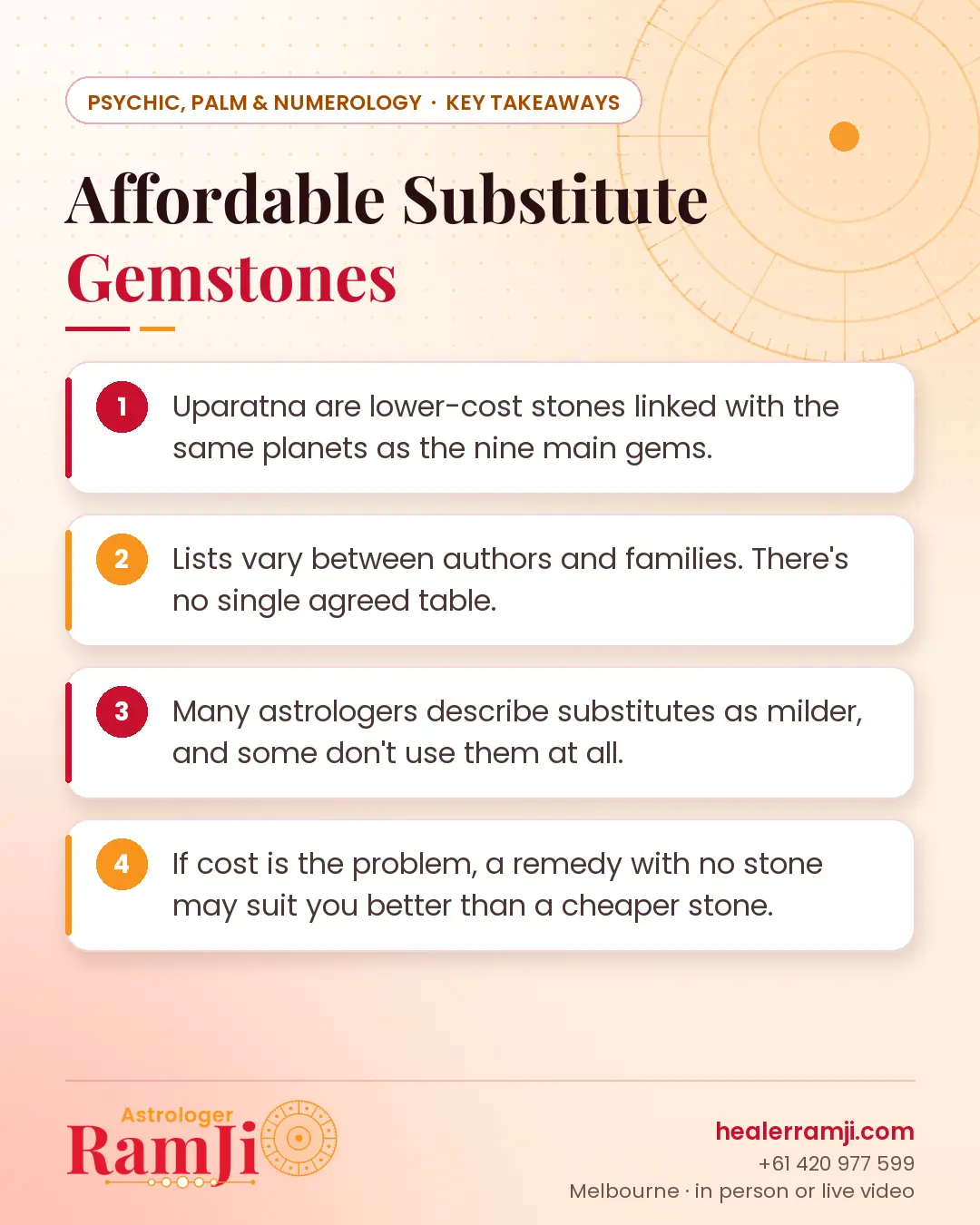
- Uparatna are lower-cost stones linked with the same planets as the nine main gems.
- Lists vary between authors and families. There's no single agreed table.
- Many astrologers describe substitutes as milder, and some don't use them at all.
- If cost is the problem, a remedy with no stone may suit you better than a cheaper stone.
What are the main gems, and what are uparatna?
The navaratna tradition links nine gems with the nine grahas: ruby with the Sun, pearl with the Moon, red coral with Mars, emerald with Mercury, yellow sapphire with Jupiter, diamond with Venus, blue sapphire with Saturn, hessonite with Rahu and cat's eye with Ketu. These are often called maharatna, the great gems.
Uparatna are other stones said to carry a similar link to the same planet. They are usually chosen because they share a colour or quality with the main gem and cost far less. In much of the tradition they are treated as gentler versions, not equal replacements.
Which substitutes are commonly suggested?
The list below reflects stones that often appear in modern lists. Treat it as a general picture, not a rule. Different authors name different stones, and your own astrologer may disagree.
- Sun (ruby): red garnet is the most common, with sunstone also mentioned.
- Moon (pearl): moonstone.
- Mars (red coral): carnelian or red jasper.
- Mercury (emerald): peridot, green tourmaline or green jade.
- Jupiter (yellow sapphire): yellow topaz or citrine.
- Venus (diamond): white sapphire, white zircon or white topaz. Some modern lists also give opal.
- Saturn (blue sapphire): amethyst, iolite or blue spinel. Lapis lazuli appears in some lists.
- Rahu (hessonite): hessonite is often less costly than the other main gems, so substitutes come up less. Some lists offer other garnets.
- Ketu (cat's eye): quartz cat's eye or tiger's eye, in place of chrysoberyl cat's eye.
The point of a substitute is the planet, not the colour alone. A green stone doesn't automatically stand in for emerald, so ask why a particular stone is being suggested.

Do all astrologers accept substitutes?
No. You will meet roughly three views. Some readers use uparatna freely, as a practical answer to cost. Some accept them but expect a weaker effect, and may suggest a larger stone or a longer period of wearing. Others insist on the main gem or nothing, and will suggest a non-gem remedy before a substitute.
None of these views has been tested in any scientific way, because the claimed effects of gemstones haven't been shown at all. The differences are matters of school and belief. If two readers give you different answers, that tells you something about how much weight the advice can bear.
Is a lab-grown stone the same as a substitute?
It's a different question. A lab-grown ruby or sapphire has the same chemistry as a natural one but usually costs much less. Traditional astrologers are split on these. Many insist that only a natural stone carries the planet's influence, while others accept lab-grown gems.
Glass and other imitations are something else again. They only look like the gem. Whatever your view, the seller should tell you plainly whether a stone is natural, lab-grown or imitation, and whether it has been treated.
Treatment matters with substitutes too. The Gemological Institute of America says natural citrine is rare and that most citrine on the market comes from heat-treated amethyst. If your astrologer insists on an untreated natural stone, that is worth knowing before you buy. Ask the jeweller, and get the answer in writing.
Is there an Australian angle?
There is, if your list includes opal. According to Geoscience Australia, Australia produces 95 per cent of the world's precious opal, and opal is the country's official national gemstone. Some families like the idea of a stone with a local connection. As with any gem, the price varies enormously with quality, so compare before you pay.
How do you buy a substitute sensibly?
Lower prices don't remove the usual risks. A few simple checks protect you:
- Set a firm budget before you look, and keep it well away from money for rent, bills or debts.
- Ask what the stone is, whether it's natural, and what treatments it has had.
- Get a second quote from a jeweller who has nothing to do with the reading.
- Keep the receipt and returns terms in writing.
- Be wary of "energised" stones sold at a premium. A ritual mark-up can't be checked.
For more on lab reports and fair prices, see our guide to gemstone certificates and buying safely.
Is a cheaper stone the right answer?
Sometimes the better question is whether you need a stone at all. In Jyotish, a gem is meant to strengthen a planet, and not every planet is one the tradition wants strengthened. A substitute doesn't change that reasoning. Our short answer on which gemstone to wear explains why the honest answer may be none.
If cost is what's stopping you, our guide to remedies that don't need a gemstone covers mantra, charity and routine, which many traditions treat as remedies in their own right.
No stone, main or substitute, can treat an illness, bring money or fix a relationship. Please don't delay medical, financial or legal help because you are wearing one.
Would a second opinion help?
A gemstone consultation looks at whether your chart calls for a stone at all, and if it does, discusses cheaper options and what to check before buying. Nothing needs to be bought. Sessions can be held by phone, WhatsApp or video, and fees are stated before any paid work. To ask a question first, get in touch.
Related service
Keep reading
Remedies That Do Not Need a Gemstone
Astrology remedies without gemstones: why many traditions favour mantra, charity and daily discipline, a planet-by-planet guide, and how to keep one up.
Read article →
Told to Buy a Costly Gemstone? A Doncaster Buyer's Pause
Told by an astrologer to buy an expensive gemstone? What to do in Doncaster before you spend thousands: written details, valuations and your rights.
Read article →
Naming a Small Business in Melbourne's North
Naming a new business in Melbourne's north? Check the name with ASIC and business.gov.au first, then use numerology only to choose between names you can use.
Read article →Quick answers
Which gemstone should I wear?
Which gemstone suits you depends on your chart and tradition, and the honest answer may be none. Here is how the choice is made and what to check first.
Read answer →Can I wear a gemstone without a reading?
You can wear any gemstone without consulting an astrologer if it's simply jewellery. Here is the traditional caution, and how to avoid overpaying.
Read answer →Talk to Vijay Ramji
Tell us what you are facing. If a reading is unlikely to help, you will be told that plainly.