
Checking Compatibility With a Co-Founder

A business partner compatibility check works best in two parts. A chart comparison, done with both people's consent, can raise questions about working styles, money and timing. A written agreement, prepared with a lawyer and accountant, answers them. The chart cannot show whether someone is honest or whether the business will succeed.
Starting a business with someone is a bit like moving in together before you have really talked about money. The energy is high, the idea feels right, and the hard questions seem like they can wait. Often they wait until something goes wrong.
Some founders like to compare birth charts before they commit. That can be a useful conversation starter. This article shows how to pair it with the practical steps that actually protect you both.
Key takeaways
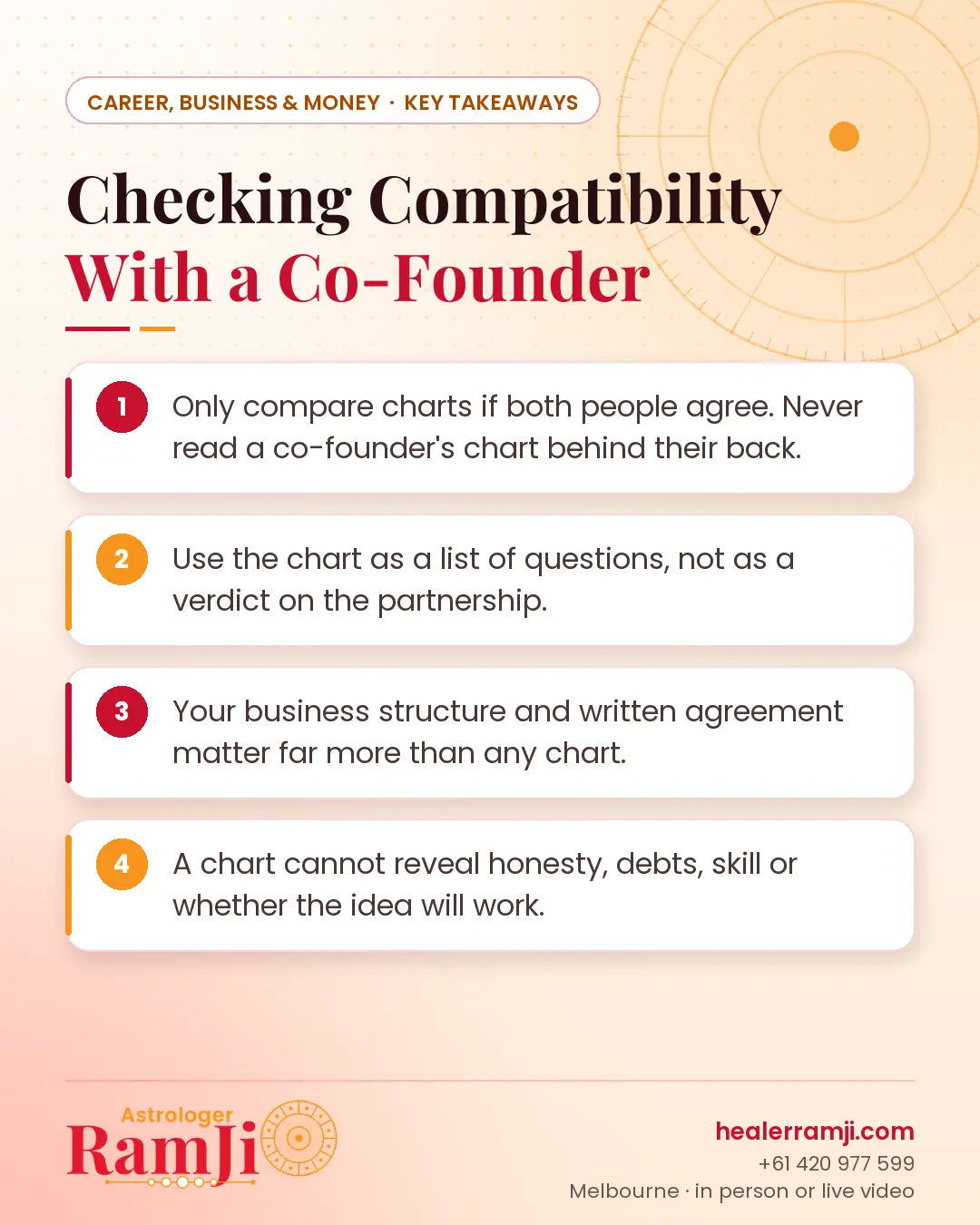
- Only compare charts if both people agree. Never read a co-founder's chart behind their back.
- Use the chart as a list of questions, not as a verdict on the partnership.
- Your business structure and written agreement matter far more than any chart.
- A chart cannot reveal honesty, debts, skill or whether the idea will work.
Why do co-founder relationships go wrong?
Most founder disputes are not about villains. They come from expectations that were never said out loud. One person thought the split was equal, while the other thought it reflected who put in the cash. One planned to work full time, the other kept a day job. One wanted to sell in five years, the other wanted to build something to pass on.
These gaps are easy to fix at the start and very hard to fix later. Anything that gets you talking early, including a chart comparison, can be worth the time.
What does a chart comparison look at?
In Vedic astrology there is no single score for business compatibility. The marriage matching system, Guna Milan, was not built for this. Instead, a reader usually looks at a handful of themes in each chart:
- The seventh house: best known for marriage, but also read for business partners and agreements between two people.
- Mercury: how each person thinks, negotiates and communicates.
- Mars and Saturn: drive, risk-taking and discipline under pressure.
- The second and eleventh houses: attitudes to saving, spending and gains.
- Current dashas: the planetary periods each person is running, which may suggest one is in an expansive phase and the other a cautious one.
Different readers weigh these differently. That is one reason to treat the results as discussion points rather than measurements.

How do you turn chart themes into real questions?
This is where the chart becomes useful. Each theme can be translated into a plain business question. Here are some generic examples:
- If one chart is read as quick and bold and the other as careful, ask: Who has the final say on spending, and up to what amount?
- If the money houses suggest different attitudes, ask: Do we reinvest profits or pay them out, and when?
- If one person's period is read as a time of change, ask: What happens if one of us wants to step back or leave?
- If communication styles differ, ask: How often do we meet, and how do we raise a problem before it grows?
Notice that none of these questions needs a chart to be valid. The chart simply gives you a reason to ask them, and a neutral way to raise awkward topics.
Partnership or company: why does the structure matter?
Many co-founders start informally and only think about structure later. In Australia, the choice has real consequences. business.gov.au explains that in a general partnership, each partner has unlimited liability for the partnership's debts, and it suggests a written partnership agreement reviewed by a lawyer.
A company works differently. According to business.gov.au's guide to companies, shareholders are generally not liable for the company's debts in their capacity as members, though directors have legal obligations and can be held personally liable if they breach them. Which structure suits you is a question for your accountant and lawyer, not your astrologer.

What should a co-founder agreement cover?
Whatever your structure, it helps to have a written agreement. The details depend on your situation, so ask a lawyer to prepare or review it. Topics founders commonly raise include:
- Who contributes what: money, time, skills, equipment and ideas
- How ownership is split, and whether it is earned over time
- Who owns the intellectual property, such as code, designs and the brand
- Roles and decision rights, and how deadlocks are broken
- Pay, profit distribution and reinvestment
- What happens if someone leaves, falls ill, stops contributing or dies
- Restrictions on competing or taking clients after leaving
Our short answer on whether to check a business partner's chart puts these practical checks first for good reason.
What about consent and privacy?
Birth details are personal. Ask your co-founder openly, explain why, and accept their answer. If they would rather not, that is not a warning sign. Many capable people have no interest in astrology. Don't look for their details through relatives, old documents or social media.
If only you are interested, a reading of your own chart can still help. It can look at how you tend to work with others, what you need from a partner and where you might be blind to risk.
What can't a chart tell you?
A chart cannot show whether your co-founder is honest, carries debts, has the skills they claim, or will stay the course. It cannot predict whether the product will find customers. Astrology is a traditional practice, and there is no scientific evidence that it predicts business outcomes.
Real due diligence still matters. Ask for references, talk to people who have worked with them, and have an accountant look at any financial records. A good chart match should never excuse a weak contract, and a difficult one should not end a sound deal.
Where does a reading fit?
If both of you are curious, a partnership compatibility reading compares charts with everyone's consent and turns the results into topics for your agreement and advisers. Once the paperwork is sorted, some founders also choose a business launch muhurat for an opening date. Our piece on choosing a startup launch date that holds up explains how to keep investor and product deadlines first.
Any fee is stated before paid work begins, what you share is confidential, and sessions can be held by phone, WhatsApp or video, so co-founders in different places can both join. To ask a question first, get in touch.
Related service

Keep reading

Working With Family Without Falling Out
Family business conflict advice: how to set clear roles, raise hard topics like pay and succession, and know when to bring in a lawyer, accountant or mediator.
Read article →
What Wealth Houses Show and What They Don't
What the second and eleventh houses mean for wealth in Vedic astrology, what dhana yogas and money periods are read for, and why a chart never replaces a budget.
Read article →
Why Astrology Should Never Pick Your Investments
No chart can choose a share, coin or property. Why astrology investing advice is risky, how to check a licensed adviser, and the warning signs of a scam.
Read article →Quick answers
Should I check a business partner's chart?
Only with their consent, and never in place of proper checks. Here is what to do first, from the agreement to legal advice, and where a chart might fit.
Read answer →Can astrology help me choose a career?
Astrology can prompt useful questions about work, but it can't pick your career. Here is what a chart may suggest, its limits, and who to ask for real advice.
Read answer →Talk to Vijay Ramji
Tell us what you are facing. If a reading is unlikely to help, you will be told that plainly.